Art Institute of Chicago
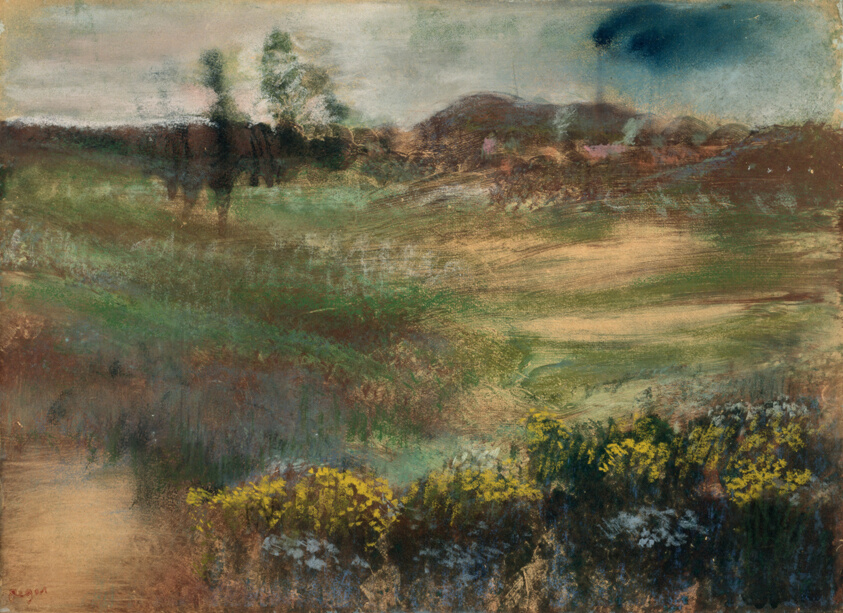
Landscape with Smokestacks
Edgar DegasLinkedCulture matchlcp-bf4856169bdb
- Date
- c. 1890
- Medium
- Pastel, over monotype, on textured cream wove paper, edge-mounted on board
- Culture
- France
- Department
- Prints and Drawings
- Institution
- Art Institute of Chicago
- Object ID
- 151507
From the Art Institute of Chicago record
Degas is best known for his images of the ballet and other scenes from modern urban life. However, periodically he explored the landscape genre, with a trip in 1869 to the Normandy Coast, for example, that resulted in a number of pastel landscapes. During the peak years of Impressionism-the 1870s and 1880s, when landscape reigned supreme among France's avant-garde-Degas was notoriously averse to the practice of open-air landscape painting. Yet in the 1890s, he produced several groups of landscapes, combining observation and invention in various ways. The artist's renewed interest was prompted by a trip he took he took through Burgundy in 1890 that inspired him to treat its landscape using the technique of monotype. A monotype is made by painting or drawing an image in greasy printer 's ink on a metal plate and then printing the plate onto a sheet of paper. Only one strong impression can usually be pulled from the plate; on occasion, a second, paler impression known as a monotype cognate can be pulled as well. Degas sometimes completed pastels over monotypes or monotype, cognates, as in Landscape with Smokestacks. He pioneered this technique in the 1870s. He began some of his monotypes on the spot, while others-possibly Landscape with Smokestacks -were recollections. Certainly, Degas's aim in such compositions was quite different from his colleague Claude Monet's preoccupation with changing atmospheric effects. While rooted in experience, Degas's landscapes of memory are brooding and mysterious.
The authoritative record is held by Art Institute of Chicago. LinkedCulture surfaces this object and its connections; it does not alter institutional metadata.
Get printable QR codesHide QR codes
Open QR codes for this object page and the museum record. They stay collapsed until needed.
Provenance & credit
As published by the source institution. Coverage varies — not every institution's open-data feed includes ownership history.
- Credit line
- Purchased from the collection of Friedrich and Louise Gutmann, and gift of Daniel C. Searle
- Provenance
- Estate of the artist, from 1917 [stamp (Lugt 658), lower left in red]; sold, Galerie Georges Petit, Paris, July 2–4 1919, lot 45. Nunes et Fiquet, Paris [Lemoisne 1946]. L. Wolff, Hamburg [Paris 1932 auc. cat.]. Unidentified private collector, to 1932 [Although the 1932 auction included the Simon and Silberberg collections, it remains unclear who owned this specific lot. It could have been Simon, Silberberg, or an unknown third party.]; sold, Galerie Georges Petit, Paris, June 9, 1932, lot 5, to Dr. Helmut Lutjens, the Director of the Amsterdam branch of Paul Cassirer, for Friedrich and Louise Gutmann, Heemstede, Holland [annotated sale catalogue obtained from Walter Feilchenfeldt]; sent by Friedrich Gutmann to Paul Graupe, Paris, 1939; sent to the Wacker-Bondy storage facility on the Boulevard Raspail, by 1945 [letter from Arthur Goldschmidt of Paul Graupe to Friedrich Gutmann]. Hans Wendland, Paris, to his brother-in-law, Hans Fritz Fankhauser, Basel [Janis 1968]; sold by Hans Fritz Fankhauser to Emile Wolf, New York, 1951 [Janis 1968]; sold by Emile Wolf, through Margo Pollins Schab, New York, to Daniel Searle, Winnetka, Ill., 1987; given by Daniel Searle and sold by the Goodman (formerly Gutmann) family to the Art Institute, 1998.
Linked open data
Authority identifiers that link this record into the wider web of cultural data — stable references you can follow to the source.
- Object type
- AAT300033973
Related across collections
Semantically similar works from Art Institute of Chicago and other institutions.