Art Institute of Chicago
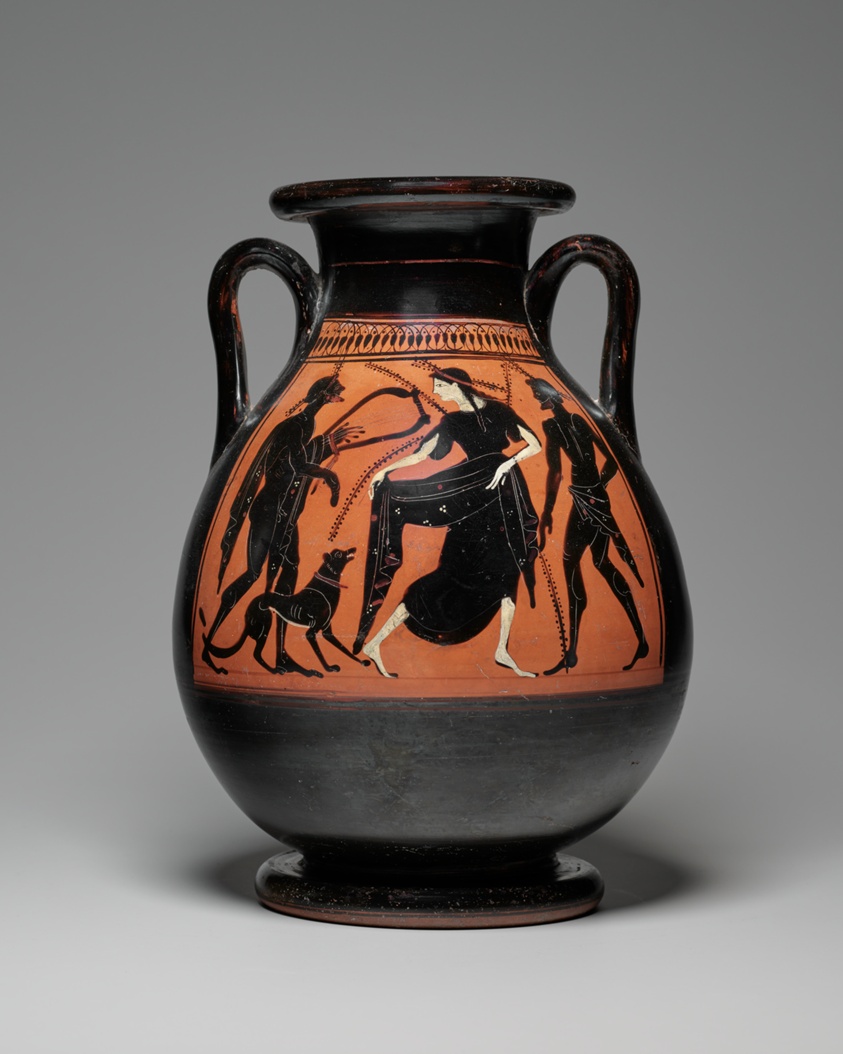
Pelike (Storage Jar)
Greek; AthensLinkedCulture matchlcp-96247048df89
- Date
- about 510-500 BCE
- Medium
- terracotta, black-figure with applied paint
- Culture
- Greece
- Department
- Arts of Greece, Rome, and Byzantium
- Institution
- Art Institute of Chicago
- Object ID
- 158
From the Art Institute of Chicago record
This ancient storage vessel is decorated in the black-figure technique, which was developed in Corinth and used widely during the Archaic period (700–480 BCE). Gloss, a slip made from refined clay, was applied to all areas intended to be black. For the figural scene the silhouettes of the figures and other elements were painted in gloss, sometimes following the lines of a preliminary sketch scratched into the surface. Using a sharp tool, the artist created details by incising through the gloss to the light clay ground below. Colors such as purple-red and white, made from a gloss with mineral pigments, were then added. After a three-stage firing process applying alternately less and more oxygen, the gloss turned black. In its finest form, it was quite shiny. On this vessel, those techniques are used by the artist to create lively scenes in which a woman dances playfully with a drape of fabric, perhaps her cloak. Male musicians accompany her with Greek instruments including a Barbiton (the string instrument which looks like a small harp) and an aulos (the wind instrument shaped like a doubled flute). The inquisitive dog adds to the sense of movement and rhythm within the scene.
The authoritative record is held by Art Institute of Chicago. LinkedCulture surfaces this object and its connections; it does not alter institutional metadata.
Get printable QR codesHide QR codes
Open QR codes for this object page and the museum record. They stay collapsed until needed.
Provenance & credit
As published by the source institution. Coverage varies — not every institution's open-data feed includes ownership history.
- Credit line
- Gift of Philip D. Armour and Charles L. Hutchinson
- Provenance
- Said to be found near Capua, 1882 [Old Register at the Art Institute of Chicago]. Augusto Mele, Naples, Italy; sold to the Art Institute of Chicago through J.C. Fletcher as agent, 1889; price reimbursed by Charles Hutchinson and Philip D. Armour, 1889.
Linked open data
Authority identifiers that link this record into the wider web of cultural data — stable references you can follow to the source.
- Object type
- AAT300193015
Related across collections
Semantically similar works from Art Institute of Chicago and other institutions.