Art Institute of Chicago
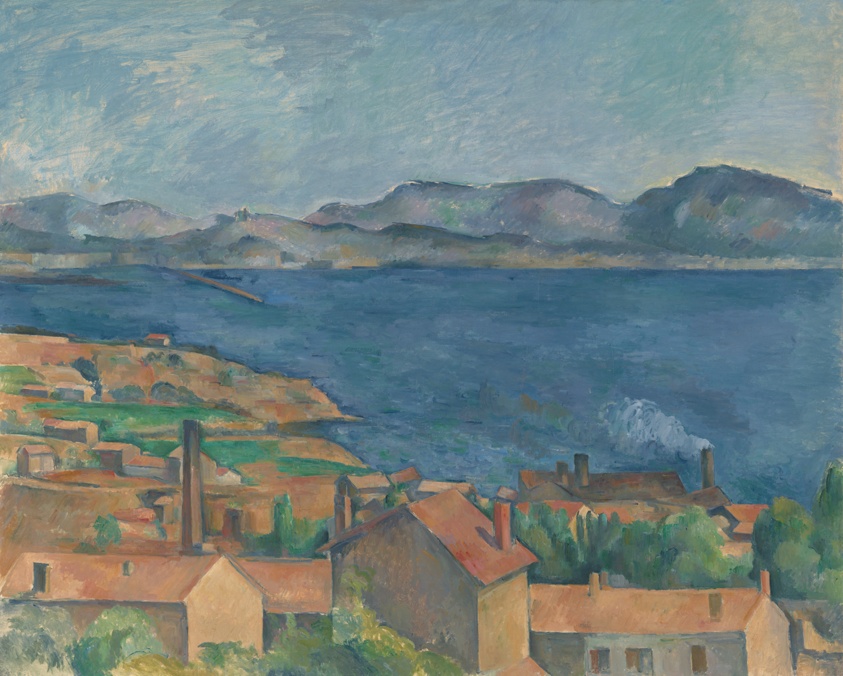
The Bay of Marseille, Seen from L'Estaque
Paul Cezanne (French, 1839–1906)LinkedCulture matchlcp-84594e346d8b
- Date
- c. 1885
- Medium
- Oil on canvas
- Culture
- France
- Department
- Painting and Sculpture of Europe
- Institution
- Art Institute of Chicago
- Object ID
- 16487
From the Art Institute of Chicago record
In a letter to his friend and teacher Camille Pissarro , Paul Cézanne compared the view of the sea from L’Estaque to a playing card, with its simple shapes and colors. The landscape’s configuration and color fascinated him. This painting is one of more than a dozen such vistas created by the artist during the 1880s. Cézanne divided the canvas into four zones—architecture, water, mountain, and sky. Although these four elements are seen repeatedly in Impressionist paintings, Cézanne’s work is very different from that of his fellow artists. Whereas their primary purpose was to record the transient effects of light, Cézanne was interested in the underlying structure and composition of the views he painted. Filling the canvas with shapes defined by strong, contrasting colors and a complex grid of horizontal, vertical, and diagonal lines, he created a highly compact, dynamic pattern of water, sky, land, and village that at once refers back to traditionally structured landscape paintings and looks forward to the innovations of Cubism. Using blocklike brushstrokes to build the space, Cézanne created a composition that seems both two- and three-dimensional. Not locked tightly in place, his forms appear to touch and shift continually, creating a sense of volume and space that strengthens the composition and brings it to life.
The authoritative record is held by Art Institute of Chicago. LinkedCulture surfaces this object and its connections; it does not alter institutional metadata.
Get printable QR codesHide QR codes
Open QR codes for this object page and the museum record. They stay collapsed until needed.
Provenance & credit
As published by the source institution. Coverage varies — not every institution's open-data feed includes ownership history.
- Credit line
- Mr. and Mrs. Martin A. Ryerson Collection
- Provenance
- The artist; sold to Ambroise Vollard (1866–1939), Paris, c. 1899 [according to New York 2006–7]; sold to Cornelis Hoogendijk (died 1911), Amsterdam, possibly in May 1899 [according to New York 2006–7, see also Musée d’Orsay, Fonds Vollard, MS 421 (4,3) fol 31, May 17, 1899, copy in curatorial file]; by descent to his heirs, on deposit at the Rijksmuseum, Amsterdam [see Henkels 1993]; sold in shares to Paul Rosenberg, Jos Hessel, and Galerie Durand-Ruel, Paris, 1920 [according to New York 2006–7]; sold through Jos Hessel to Martin A. Ryerson (1856–1932), Chicago, June 12, 1920 [see purchase receipt, copy in curatorial file]; bequeathed to the Art Institute of Chicago, 1933.
Linked open data
Authority identifiers that link this record into the wider web of cultural data — stable references you can follow to the source.
- Object type
- AAT300033618
Related across collections
Semantically similar works from Art Institute of Chicago and other institutions.