Art Institute of Chicago
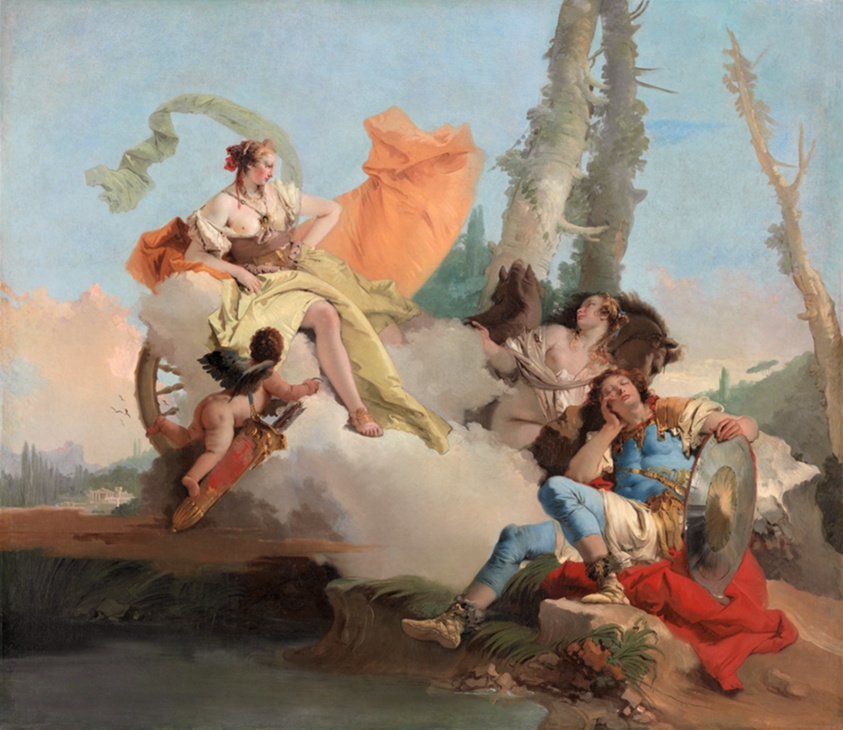
Armida Encounters the Sleeping Rinaldo
Giovanni Battista Tiepolo (Italian, 1696–1770)LinkedCulture matchlcp-fed58860a502
- Date
- c. 1742–45
- Medium
- Oil on canvas
- Culture
- Italy
- Department
- Painting and Sculpture of Europe
- Institution
- Art Institute of Chicago
- Object ID
- 16488
This painting likely once graced a large hall at the Palazzo Corner in Venice along with several others. The suite illustrates the ill-fated love of Armida and Rinaldo from Torquato Tasso’s 1581 epic poem Gerusalemme liberata (Jerusalem Delivered). The story takes place during the First Crusade, an eleventh-century military expedition in which Christian knights attempted to seize control of Jerusalem and check the power of the Muslims who ruled the city. In this scene, the beautiful sorceress Armida encounters the knight Rinaldo as he sleeps and decides to carry him away on her cloud-borne chariot. When Rinaldo wakes, he immediately falls for Armida and forgets his quest in Jerusalem. Giovanni Battista Tiepolo painted a vast, open expanse of sky and scenery and elaborately arranged the figures, draperies, clouds, and trees to animate the composition. Although Tasso’s story symbolizes the conflict between love and duty, Tiepolo’s depiction of a magical world—enhanced by effervescent colors and dense, creamy paint—seems to evoke only love’s enchantment. Tiepolo’s paintings combine virtuosic draftsmanship with seemingly spontaneous execution, a formula perfectly suited to the large-scale works that he created to decorate palaces and churches throughout Italy, Germany, and Spain.
The authoritative record is held by Art Institute of Chicago. LinkedCulture surfaces this object and its connections; it does not alter institutional metadata.
Get printable QR codesHide QR codes
Open QR codes for this object page and the museum record. They stay collapsed until needed.
Provenance & credit
As published by the source institution. Coverage varies — not every institution's open-data feed includes ownership history.
- Credit line
- Bequest of James Deering
- Provenance
- Possibly one of four scenes from Tasso made for the 'gabinetto degli specchi' of the Palazzo Corner a San Polo, Venice [according to inventories and other documents discussed by Romanelli 1998]. Count Giovanni Serbelloni, Venice in 1838; by descent, until possibly 1886 [Molmenti 1911 and Knox 1978]. Giulio Cartier, Genoa by 1908 [Malaquzzi Valeri 1908]; Sedelmeyer Gallery, Paris, in 1912 [Ojetti 1912]; James Deering (d. 1925), Vizcaya, from 1913 [information sheet in curatorial file]; bequeathed,1925.
Linked open data
Authority identifiers that link this record into the wider web of cultural data — stable references you can follow to the source.
- Object type
- AAT300033618
Related across collections
Semantically similar works from Art Institute of Chicago and other institutions.