Art Institute of Chicago
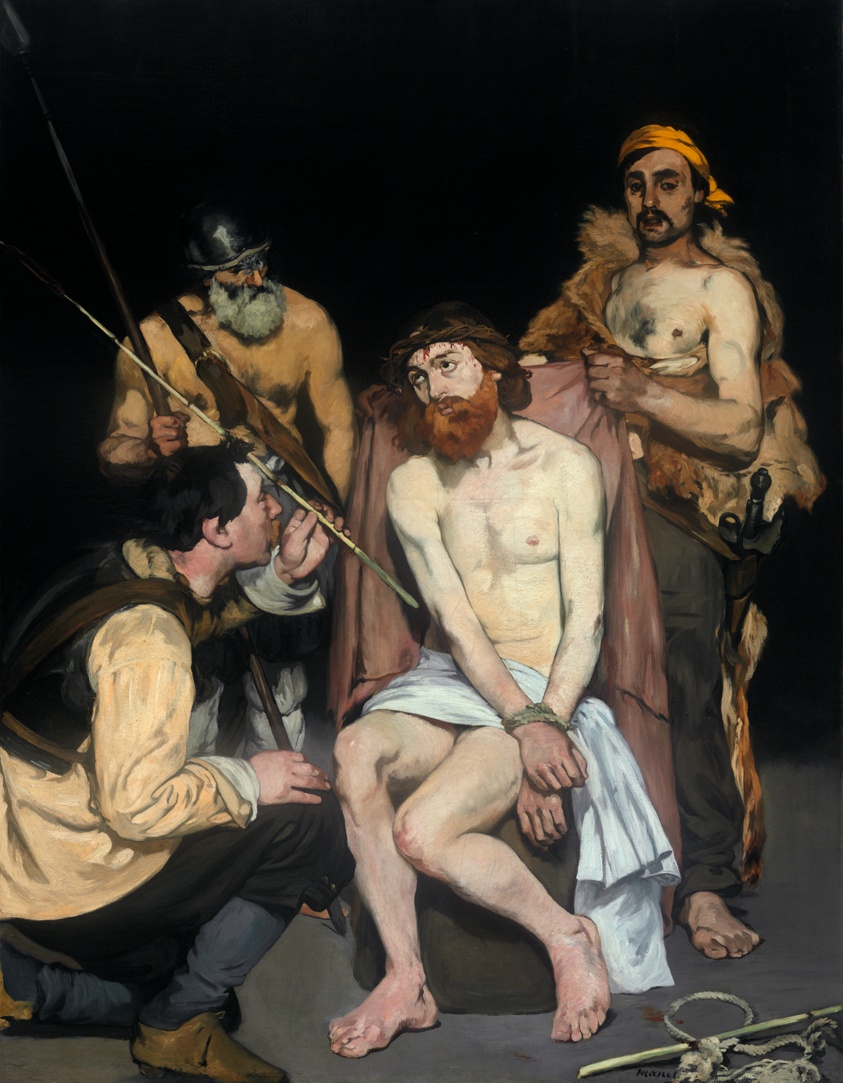
Jesus Mocked by the Soldiers
Édouard Manet (French, 1832–1883)LinkedCulture matchlcp-1088101e6ec3
- Date
- 1865
- Medium
- Oil on canvas
- Culture
- France
- Department
- Painting and Sculpture of Europe
- Institution
- Art Institute of Chicago
- Object ID
- 16499
From the Art Institute of Chicago record
Throughout his career Édouard Manet managed to shock and confound the public with his bold technique and unorthodox approach to subject matter. The most startling feature of this painting is that he painted it at all. Following the advent of the Realist movement, which grounded art in the here and now, avant-garde artists in France did not pursue religious themes. While Manet was primarily a painter of secular subjects, he was also interested in art history, which led him on at least two occasions to depict the biblical narratives that had compelled artists for many centuries. This work might also have been inspired by the popular 1863 biography Vie de Jésus (Life of Jesus) by the French philosopher and historian Joseph-Ernest Renan, a controversial work that emphasized Christ’s humanity. Here, Manet depicted Jesus at the end of his life, beaten and awaiting crucifixion. The Roman soldiers force him to don a crown of thorns and proffer a reed “scepter” and purple cloak, all intended to ridicule him as “King of the Jews,” a title bestowed ironically by his tormenters. Manet transformed this sacred narrative into a gritty drama that marries realism with theatricality. He presented Jesus frontally, emphasizing his vulnerability and human physicality. Jesus seems exhausted and limp. The canvas’s visible brushstrokes and color palette create a sense of materiality that further evokes a palpable, unidealized Christ, who notably lacks a halo. Is he a holy being emanating divine light or a real man posing under a studio spotlight? The painting caused a scandal in its own time for precisely this ambiguity.
The authoritative record is held by Art Institute of Chicago. LinkedCulture surfaces this object and its connections; it does not alter institutional metadata.
Get printable QR codesHide QR codes
Open QR codes for this object page and the museum record. They stay collapsed until needed.
Provenance & credit
As published by the source institution. Coverage varies — not every institution's open-data feed includes ownership history.
- Credit line
- Gift of James Deering
- Provenance
- Estate of the artist, Paris, 1883 [the inventory lists the painting as no. 17 as Le Christ insulté par les soldats]; by descent to Léon Leenhoff, Paris, 1883; sold to Boussod et Valadon, Paris, May 31, 1893, for 3,500 francs [this and the following per dealer’s stock book 13, no. 23074, as Les Christ insulté par les Soldats, published online at http://www.getty.edu/research/tools/digital_collections/goupil_cie/books.html]; sold to Jean-Baptiste Faure (d. 1914), Paris, April 14, 1894, for 8,000 francs; partially sold to Durand-Ruel, Paris, April 17, 1894 [per Durand-Ruel, Paris, stock book (no. 3006); copy of archival reference in curatorial object file]; partially transferred from Durand-Ruel, Paris, to Durand-Ruel, New York, October 23, 1911 [this and the following per Durand-Ruel, New York, stock books (no. 3461, as Ecce homo, le Christ insulté par les soldats, 1865); copy of archival reference in curatorial object file]; sold to James Deering (d. 1925), Chicago, October 23, 1911, for $44,000; bequeathed to the Art Institute of Chicago, 1925.
Linked open data
Authority identifiers that link this record into the wider web of cultural data — stable references you can follow to the source.
- Object type
- AAT300033618
Related across collections
Semantically similar works from Art Institute of Chicago and other institutions.