Art Institute of Chicago
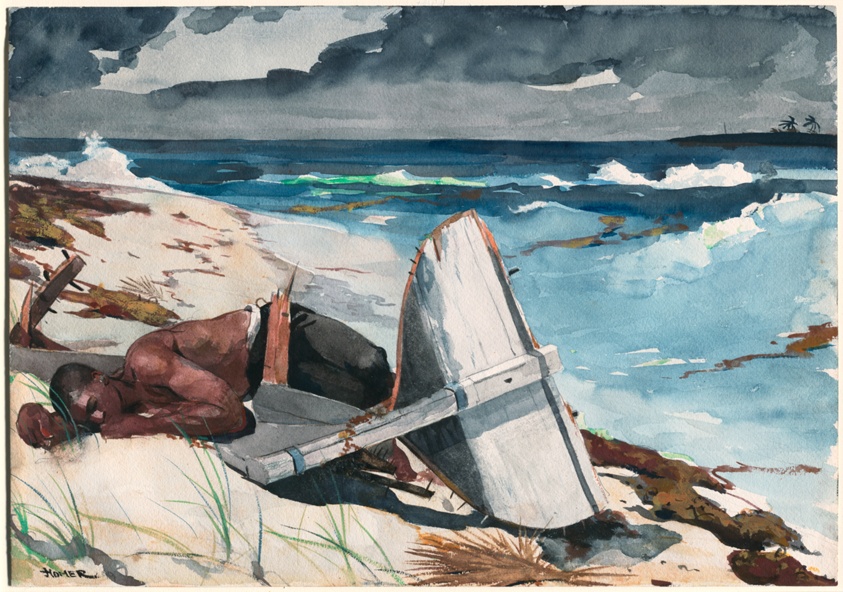
After the Hurricane, Bahamas
Winslow HomerLinkedCulture matchlcp-bcddaaacf48f
- Date
- 1899
- Medium
- Transparent watercolor, with touches of opaque watercolor, rewetting, blotting and scraping, over graphite, on moderately thick, moderately textured (twill texture on verso), ivory wove paper
- Culture
- United States
- Department
- Prints and Drawings
- Institution
- Art Institute of Chicago
- Object ID
- 16776
From the Art Institute of Chicago record
Revered as America’s master of watercolor, Winslow Homer did not begin working in the medium until the mature age of thirty-seven. As a watercolorist, Homer adapted his practice to the diverse locales he visited. His sojourns in the tropics took him to the Bahamas, Bermuda, Cuba, and various locations in Florida. In each new environment, the self-taught artist pushed the flexible medium in new directions as he applied his increasingly sophisticated understanding of color and light to a new set of atmospheric conditions. This compelling watercolor was painted during Homer’s second trip to the Bahamas in the winter of 1898–99. Depicting a luckless man washed up on the beach, surrounded by fragments of his shattered craft, the work demonstrates the artist’s fascination with the rapid and dangerous weather changes of the region. Here sunlight glints through gradually thinning storm clouds. Homer employed thickly applied opaque red and yellow pigments for the seaweed tossed on the sand, creating a contrast with the thin washes and fluid brushstrokes that he used to render the receding waves.
The authoritative record is held by Art Institute of Chicago. LinkedCulture surfaces this object and its connections; it does not alter institutional metadata.
Get printable QR codesHide QR codes
Open QR codes for this object page and the museum record. They stay collapsed until needed.
Provenance & credit
As published by the source institution. Coverage varies — not every institution's open-data feed includes ownership history.
- Credit line
- Mr. and Mrs. Martin A. Ryerson Collection
- Provenance
- The artist to his brother, Charles S. Homer, Jr. (1834–1917), New York, by 1910 [according to correspondence from Abigail Booth Gerdts to the Art Institute, February 10, 2007]. Charles W. Gould (1849–1931), New York, by 1915 [Brooklyn exh. cat. 1915]. Sold by Knoedler and Company, New York, to Martin A. Ryerson (1856–1932), Chicago, November 11, 1915 [invoice]; given to the Art Institute, 1933.
Linked open data
Authority identifiers that link this record into the wider web of cultural data — stable references you can follow to the source.
- Object type
- AAT300033973
Part of a LinkedCulture topic
 American Watercolor Landscape Art
These objects are predominantly watercolor and drawing works by American artists depicting natural landscapes, outdoor recreational activities, and coastal or wilderness scenes from the 19th century.
63 objects from 3 institutions
Related across collections
Semantically similar works from Art Institute of Chicago and other institutions.