Art Institute of Chicago
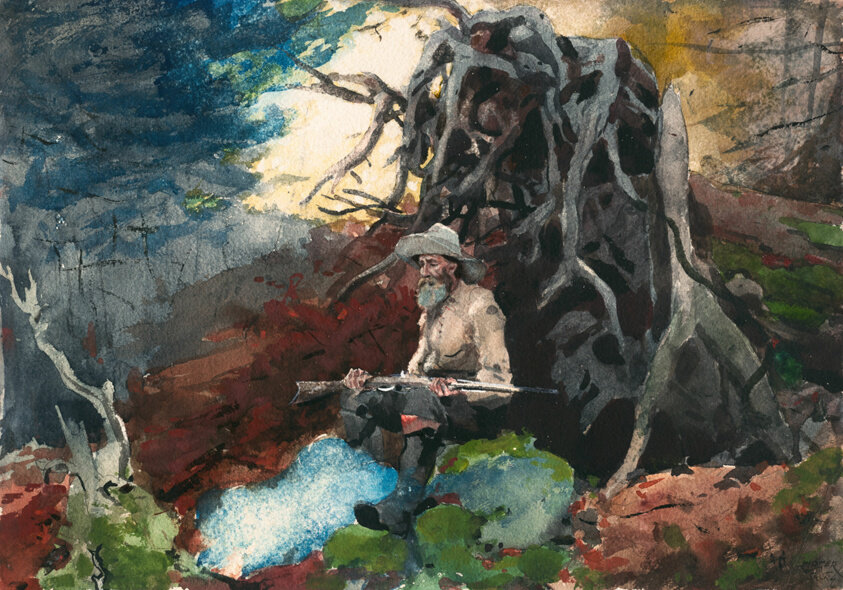
Campfire, Adirondacks
Winslow HomerLinkedCulture matchlcp-bcddaaacf48f
- Date
- c. 1892
- Medium
- Transparent and opaque watercolor, with blotting and scraping, on thick, moderately-textured, ivory wove paper
- Culture
- United States
- Department
- Prints and Drawings
- Institution
- Art Institute of Chicago
- Object ID
- 16782
From the Art Institute of Chicago record
In Campfire, Adirondacks , the guide Rufus Wallace is seated among the sheltering roots of a giant overturned hemlock. The tree’s roots are expressive formal elements in their own right, but these ancient tentacles also seem to protect the resting man. Like many of Homer’s Adirondacks watercolors, Campfire, Adirondacks was conceived on the spot, with washes laid in to suggest areas of light and shadow, but the artist probably finished the work back in his studio in Maine or at the North Woods Club. Conveying a convincing sense of immediacy and spontaneity, Homer’s watercolors were often the result of deliberate planning and several campaigns of painting. Sometimes ephemeral effects were difficult to recapture in the studio, as in the smoke of the campfire where color was applied and blotted repeatedly. Visual evidence indicates that Homer used resist to define the crooked tree trunks on the lefthand side of the composition. Without this tool, it would have been impossible to achieve the intricate contours of the trunks while simultaneously applying an even wash to the surroundings. Over a preliminary gray wash, Homer, following his graphite underdrawing, would have brushed on the resist in the shape of the tree trunks. Even before it dried, it would form a strong, cohesive film on the paper’s surface without soaking into the fibers; because oil repels water, it would have remained undisturbed while Homer brushed dark-blue wash across it and the neighboring area. Once the wash dried, he would have scrubbed off the resist with a dull scraper or stiff brush and a solvent such as turpentine. Homer’s vigorous cleaning may have broken up the resist , scattering tiny fragments that became lodged in slow-drying, dense, or gum-rich passages of watercolor elsewhere on the sheet. When he was finished, the forms of the trunks were visible against the blue background.
The authoritative record is held by Art Institute of Chicago. LinkedCulture surfaces this object and its connections; it does not alter institutional metadata.
Get printable QR codesHide QR codes
Open QR codes for this object page and the museum record. They stay collapsed until needed.
Provenance & credit
As published by the source institution. Coverage varies — not every institution's open-data feed includes ownership history.
- Credit line
- Mr. and Mrs. Martin A. Ryerson Collection
- Provenance
- The artist to his brother, Charles S. Homer, Jr. (1834–1917), New York, by 1910 [according to correspondence from Abigail Booth Gerdts to the Art Institute, February 10, 2007]. Charles W. Gould (1849–1931), New York, by 1915 [Brooklyn exh. cat. 1915]. Sold by Knoedler and Company, New York, to Martin A. Ryerson (1856–1932), Chicago, November 11, 1915 [invoice]; given to the Art Institute, 1933.
Linked open data
Authority identifiers that link this record into the wider web of cultural data — stable references you can follow to the source.
- Object type
- AAT300033973
Part of LinkedCulture topics
 American Landscape and Coastal Paintings
These works are 19th-century oil paintings depicting natural landscapes and seascapes from the northeastern United States, particularly coastal New England regions and rocky shores.
140 objects from 4 institutions
 American Watercolor Landscape Art
These objects are predominantly watercolor and drawing works by American artists depicting natural landscapes, outdoor recreational activities, and coastal or wilderness scenes from the 19th century.
63 objects from 3 institutions
Related across collections
Semantically similar works from Art Institute of Chicago and other institutions.