Art Institute of Chicago
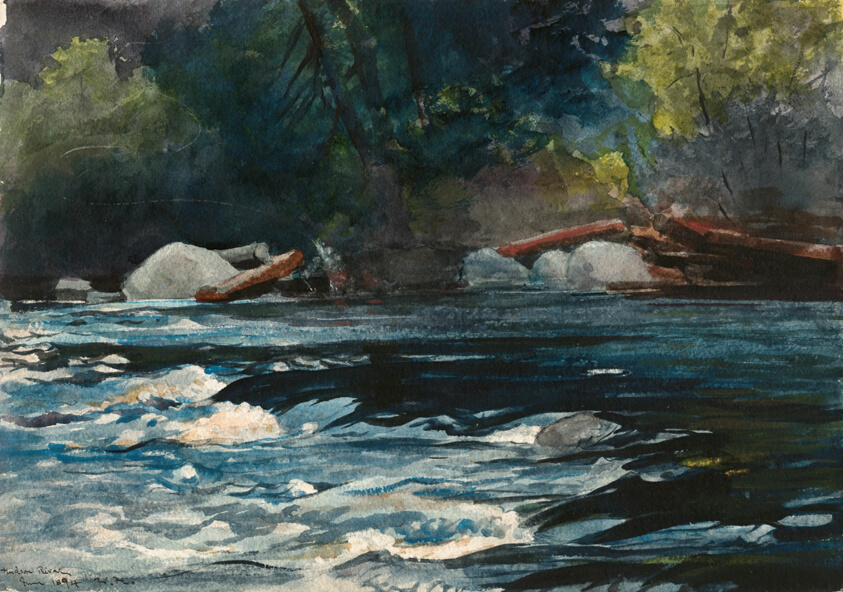
The Rapids, Hudson River, Adirondacks
Winslow HomerLinkedCulture matchlcp-bcddaaacf48f
- Date
- 1894
- Medium
- Transparent watercolor, with traces of opaque watercolor, blotting, and scraping, over graphite, on thick, rough-textured, ivory wove paper
- Culture
- United States
- Department
- Prints and Drawings
- Institution
- Art Institute of Chicago
- Object ID
- 16823
From the Art Institute of Chicago record
By the time Homer first began visiting the Adirondacks in the 1870s, commercial logging operations in the region were beginning to destroy large tracts of forest and to clog the rivers. He acutely observed and recorded these events in his watercolors, rarely passing explicit judgment. In The Rapids, Hudson River, Adirondacks , the artist combined themes of fishing and logging. On first encounter, this watercolor is peaceful and intimate, a virtuoso study of the movement of the river’s surface over partially submerged rocks. Long, painterly strokes of black watercolor over layers of blue describe the depth and speed of the water, while areas of bright white paper have been revealed by scraping to indicate the bubbling froth of whitewater rapids. It is only along the far bank that one becomes aware of the presence of man in this tranquil landscape, implied by the clean-cut logs lying haphazardly along the rocky bank. Even more subtle is Homer’s suggestion of a fisherman’s presence, indicated by the leaping fish at river’s edge, where the artist used his knife blade to sketch the serpentine motion of a fishing line in mid-cast. The fisherman is invisible, yet we are made to understand that the presence of human beings alters nature profoundly.
The authoritative record is held by Art Institute of Chicago. LinkedCulture surfaces this object and its connections; it does not alter institutional metadata.
Get printable QR codesHide QR codes
Open QR codes for this object page and the museum record. They stay collapsed until needed.
Provenance & credit
As published by the source institution. Coverage varies — not every institution's open-data feed includes ownership history.
- Credit line
- Mr. and Mrs. Martin A. Ryerson Collection
- Provenance
- The artist to his brother, Charles S. Homer, Jr. (1834–1917), New York, by 1910 [according to correspondence from Abigail Booth Gerdts to the Art Institute, February 10, 2007]. Charles W. Gould (1849–1931), New York, by 1914 [Art In America 1914]. Sold by Knoedler and Company, New York, to Martin A. Ryerson (1856–1932), Chicago, November 11, 1915 [invoice]; given to the Art Institute, 1933.
Linked open data
Authority identifiers that link this record into the wider web of cultural data — stable references you can follow to the source.
- Object type
- AAT300033973
Part of LinkedCulture topics
 American Landscape and Coastal Paintings
These works are 19th-century oil paintings depicting natural landscapes and seascapes from the northeastern United States, particularly coastal New England regions and rocky shores.
140 objects from 4 institutions
 American Watercolor Landscape Art
These objects are predominantly watercolor and drawing works by American artists depicting natural landscapes, outdoor recreational activities, and coastal or wilderness scenes from the 19th century.
63 objects from 3 institutions
Related across collections
Semantically similar works from Art Institute of Chicago and other institutions.