Art Institute of Chicago
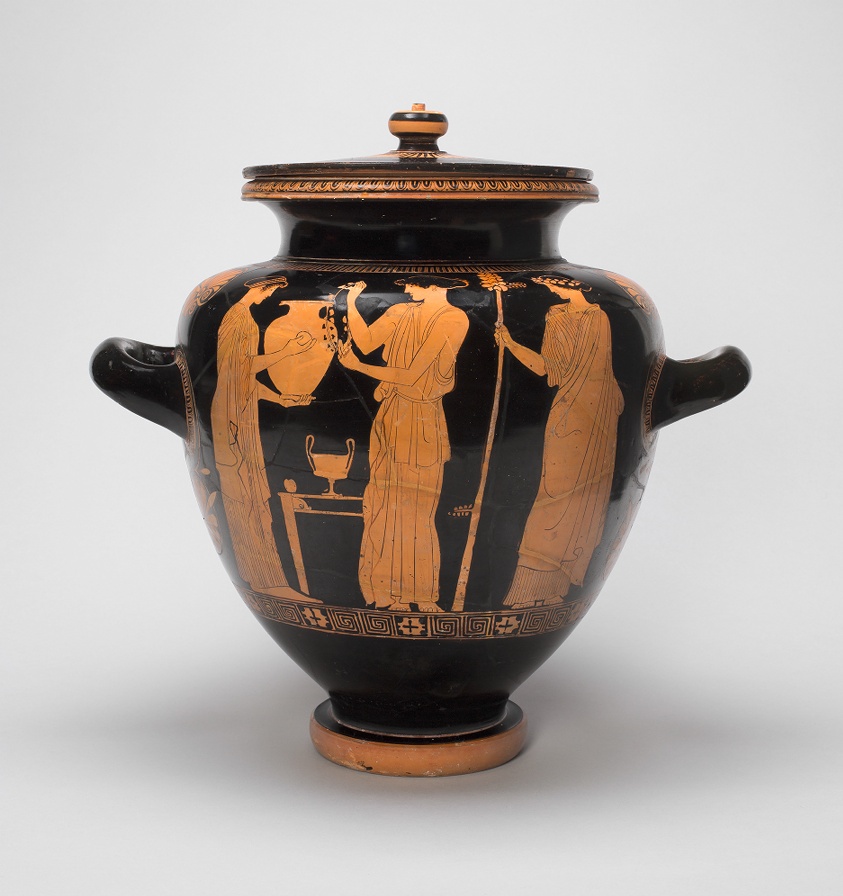
Stamnos (Mixing Jar)
Attributed to the Chicago PainterLinkedCulture matchlcp-8133e9c80d98
- Date
- about 450 BCE
- Medium
- terracotta, red-figure
- Culture
- Athens
- Department
- Arts of Greece, Rome, and Byzantium
- Institution
- Art Institute of Chicago
- Object ID
- 177
From the Art Institute of Chicago record
This refined Athenian stamnos (pl. stamnoi) was used to mix water and wine. Also valued for its beauty, this red-figure vessel (so called because the figures remain the natural color of the clay) portrays either Greek women or maenads, female participants in rites celebrating Dionysos, the god of wine. But unlike the frenzied and whirling figures of other Greek vases, these women convey calm, even elegance. This tender serenity, coupled with a softer, somewhat freer form, is a hallmark of the artist (referred to as the Chicago Painter because of this vase) and has been used to identify other works by him, principally similar stamnoi. Working in the potters’ quarter of mid-fifth-century BC Athens, the painter was active during the construction of the Parthenon, the stylistic influence of which can be seen here. He worked closely with a master potter whose vases were individually shaped in a prescribed range of configurations. With refined designs that are gracefully adapted to its shape, this stamnos is a fine example of red-figure painting during the Classical era. It retains its original lid, a rarity among ancient vases.
The authoritative record is held by Art Institute of Chicago. LinkedCulture surfaces this object and its connections; it does not alter institutional metadata.
Get printable QR codesHide QR codes
Open QR codes for this object page and the museum record. They stay collapsed until needed.
Provenance & credit
As published by the source institution. Coverage varies — not every institution's open-data feed includes ownership history.
- Credit line
- Gift of Philip D. Armour and Charles L. Hutchinson
- Provenance
- Said to be found at either Capua, 1884 [Old Register at the Art Institute of Chicago] or Nola [William M.R. French, 1889 travel notebook, unpublished manuscript, Art Institute of Chicago Archives]. Augusto Mele, Naples, Italy; sold to the Art Institute of Chicago through J.C. Fletcher as agent, 1889; price reimbursed by Charles Hutchinson and Philip D. Armour, 1889.
Linked open data
Authority identifiers that link this record into the wider web of cultural data — stable references you can follow to the source.
- Object type
- AAT300193015
Related across collections
Semantically similar works from Art Institute of Chicago and other institutions.