Art Institute of Chicago
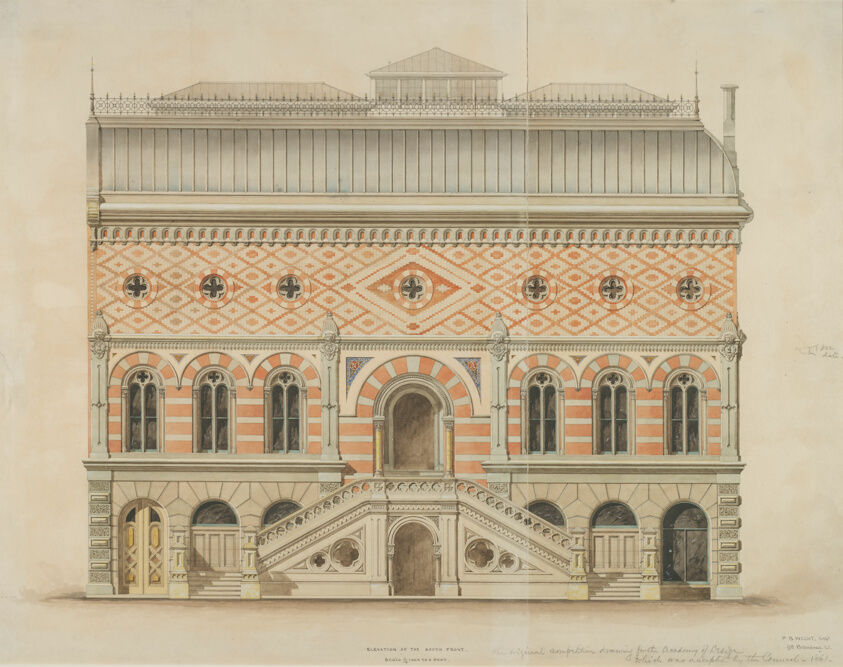
National Academy of Design Competition, New York, New York, South Elevation
Peter Bonnett WightLinkedCulture matchlcp-015302d5d26c
- Date
- 1861
- Medium
- Ink, watercolor, and gouache on paper
- Culture
- New York City
- Department
- Architecture and Design
- Institution
- Art Institute of Chicago
- Object ID
- 178931
From the Art Institute of Chicago record
Trained in New York, Peter Bonnett Wight was one of the pioneers of the American architectural profession. Wight was inspired by theories of ornament, color, and historicism found in the writings of English architect and theorist John Ruskin. These concerns led to his very early adoption of the High Victorian Gothic for such important commissions as the 1861 National Academy of Design in New York, which did much to popularize this eclectic style in the United States. The National Academy’s polychromatic herringbone brick and Gothic tracery were drawn from the Doge’s Palace in Venice—a building Ruskin believed was the most important Gothic structure in the world. Wight moved to Chicago after the Great Fire of 1871, and became an early promoter of progressive architecture as well as an accomplished critic. His 1919 donation of his library, drawings, and personal papers provides an invaluable look at the ideas and trends guiding architects in the early years of the profession.
The authoritative record is held by Art Institute of Chicago. LinkedCulture surfaces this object and its connections; it does not alter institutional metadata.
Get printable QR codesHide QR codes
Open QR codes for this object page and the museum record. They stay collapsed until needed.
Provenance & credit
As published by the source institution. Coverage varies — not every institution's open-data feed includes ownership history.
- Credit line
- Gift of Peter Bonnett Wight
Linked open data
Authority identifiers that link this record into the wider web of cultural data — stable references you can follow to the source.
- Object type
- AAT300054197
Related across collections
Semantically similar works from Art Institute of Chicago and other institutions.