Art Institute of Chicago
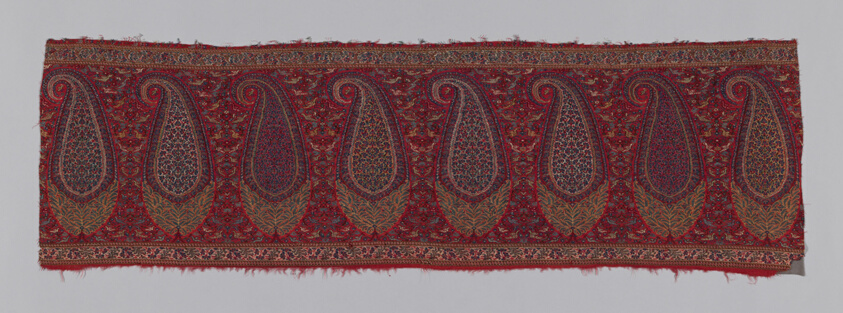
Shawl Border (Pallu)
India, Kashmir- Date
- c. 1820
- Medium
- Wool, double interlocking 2:2 'S' twill tapestry weave; main warp fringe
- Culture
- Kashmir
- Department
- Textiles
- Institution
- Art Institute of Chicago
The earliest Kashmir shawls introduced to Europe were made of white cashmere wool with decorated ends containing rows of stylized floral buta motifs. The pattern became known as paisley in English, after the town in Scotland that was a center of shawl weaving. The fine wool of a shawl’s central area was always the most fragile component, and this long shawl has been mended with two nearly invisible seams across the central white field. Europeans valued Kashmir shawls so highly that even fragments of the decorative borders were preserved, collected, and treasured.
The authoritative record is held by Art Institute of Chicago. LinkedCulture surfaces this object and its connections; it does not alter institutional metadata.
Get printable QR codesHide QR codes
Open QR codes for this object page and the museum record. They stay collapsed until needed.
Linked open data
Authority identifiers that link this record into the wider web of cultural data — stable references you can follow to the source.
- Object type
- AAT300209261
Related across collections
Semantically similar works from Art Institute of Chicago and other institutions.