Art Institute of Chicago
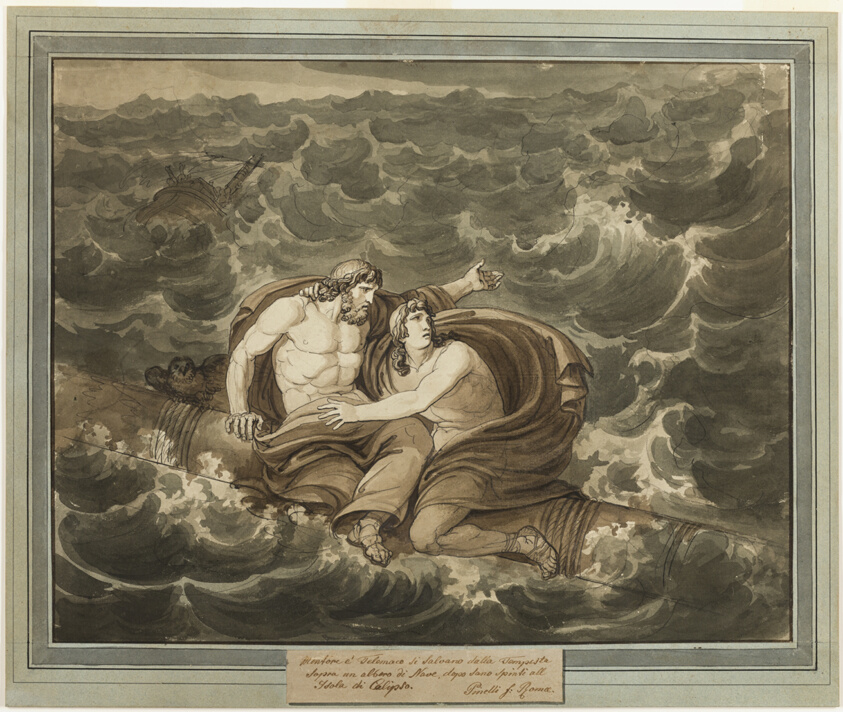
Mentor and Telemachus, Having Survived the Storm, Are Spirited to the Island of Calypso on a Mast, from The Adventures of Telemachus, Book 6
Bartolomeo PinelliLinkedCulture matchlcp-3462d0c6c56d
- Date
- 1808
- Medium
- Pen and black ink, with brush and gray and brown wash, over traces of black chalk on ivory laid paper, laid down on board
- Culture
- Italy
- Department
- Prints and Drawings
- Institution
- Art Institute of Chicago
- Object ID
- 17998
From the Art Institute of Chicago record
These twelve drawings depict scenes from the French novel The Adventures of Telemachus (Les aventures de Télémaque) by François Fénelon. First published in 1699, it was one of the most popular books of the 1700s and 1800s. Telemachus is the son of Ulysses from Homer’s Odyssey , the first four books of which describe the hero’s search for his father. Fénelon invented further adventures for Telemachus, in which he undergoes many trials while accompanied by his tutor, Mentor, who is actually the goddess Minerva (the embodiment of wisdom) in human disguise. A scathing critique of autocratic government and a diatribe against war, the book denounces luxury and decadence and calls for the simplicity and equality Fénelon believed ancient Greece best exemplified. Pinelli illustrated scenes from books 1–8 and one scene from book 18, and probably planned to illustrate more from the 24 books of the text. Throughout, he celebrates the heroic nude, displaying a deep knowledge of ancient Roman sculpture. His style, influenced by Jacques-Louis David and John Flaxman, is characterized by bold, almost cartoonish contours, monochromatic washes, and frieze-like arrangements of figures. On their way from Greece to Italy, Telemachus and Mentor are shipwrecked by Neptune on the island of Calypso. Telemachus’s account of his adventures to Calypso ends here, and the next phase of his adventures begins. The owl shown here is Minerva’s attribute and signals that Mentor is Minerva. The word “mentor” that we use today comes from his name.
The authoritative record is held by Art Institute of Chicago. LinkedCulture surfaces this object and its connections; it does not alter institutional metadata.
Get printable QR codesHide QR codes
Open QR codes for this object page and the museum record. They stay collapsed until needed.
Provenance & credit
As published by the source institution. Coverage varies — not every institution's open-data feed includes ownership history.
- Credit line
- Wirt D. Walker Fund
- Provenance
- Sold by Walter Schatzki (died 1983), New York, to the Art Institute, 1963.
Linked open data
Authority identifiers that link this record into the wider web of cultural data — stable references you can follow to the source.
- Object type
- AAT300033973
Related across collections
Semantically similar works from Art Institute of Chicago and other institutions.