Art Institute of Chicago
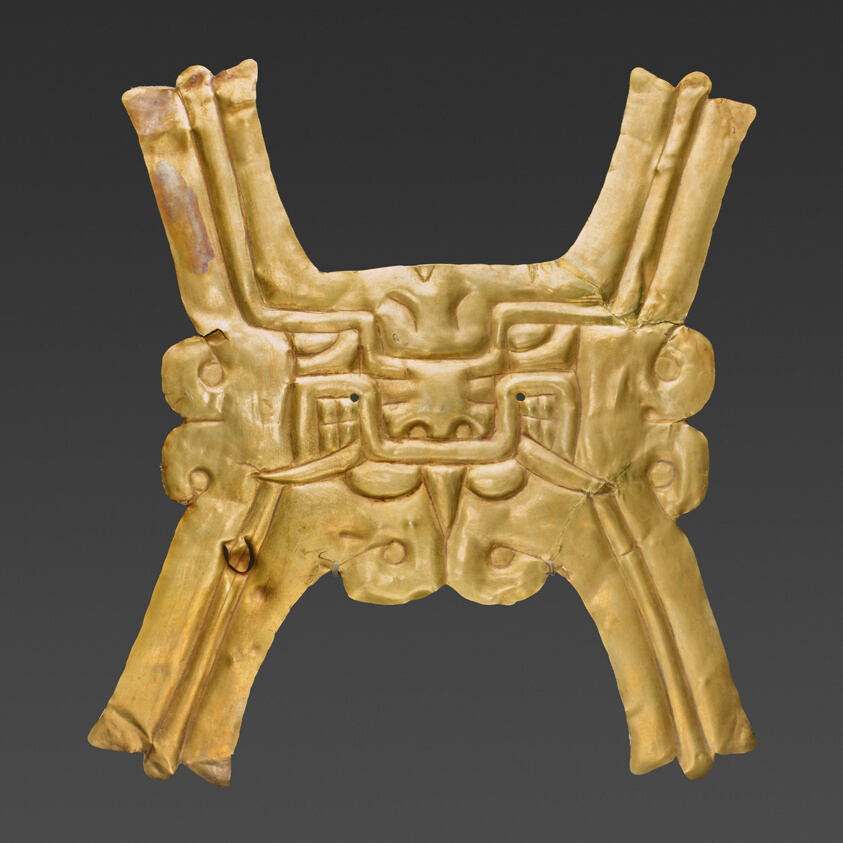
Gold Pectoral with Zoomorphic Face
ChavínLinkedCulture matchlcp-98064c3aab15
- Date
- c. 500 BCE
- Medium
- Gold
- Culture
- Peruvian North Coast
- Department
- Arts of the Americas
- Institution
- Art Institute of Chicago
- Object ID
- 184361
From the Art Institute of Chicago record
The archaeological site of Chavín de Huántar, high in a valley in the northern Andes of Peru, was a seat of economic, political, and religious power, giving rise to art and symbolic imagery that deeply affected the Andean world between 900 and 200 BCE. The rulers of Chavín brought about a cultural synthesis, adapting architectural and sculptural forms that had been associated with ruler-ship by the urban coastal societies of Peru for at least a thousand years. Artists created a new imagery, deriving forms from both the human figure and dominant predators—caymans, harpy eagles, jaguars, and pumas, some of them native to the Amazon forests east of the Andes mountains. These animal and anthropomorphic icons were often combined in a fearsome visual vocabulary. Expressed in imposing architectural reliefs, monumental three-dimensional sculptures, textile designs, and splendid ritual attire and portable objects, this symbolic imagery was emblematic of Chavín priestly rulers and the warrior aristocracy, affirming their spiritual connections with the domain of animal powers and the deified forces and phenomena of nature. Chavín art was a distinctly Andean expression of the cosmological and religious worldview that once held sway throughout the Americas. This pectoral is a rare example of the attire worn by a Chavín leader on ceremonial occasions. Metallurgy was well developed in the Andes; to make this object, an artisan would first have cut a hammered sheet of gold and copper alloy into a rectangular shape, with four "arms" extending at the corners in a cruciform pattern; then he used a sharp instrument to engrave the design of the mask and the ornamental curls and linear appendages; the sculptural low relief was achieved by hammering the metal over a carved wooden mold. The menacing face with its zigzag eyebrows, bulbous nose, and fanged, grinning mouth is an iconic type found on gold work, stone monuments, textiles, and ceramic vessels. Many objects of Chavín gold work are found in broken condition: the deliberate damage done to this piece was undoubtedly inflicted when it was ritually "killed" for burial and sent to accompany its wearer on his journey to the world of the ancestor spirits.
The authoritative record is held by Art Institute of Chicago. LinkedCulture surfaces this object and its connections; it does not alter institutional metadata.
Get printable QR codesHide QR codes
Open QR codes for this object page and the museum record. They stay collapsed until needed.
Provenance & credit
As published by the source institution. Coverage varies — not every institution's open-data feed includes ownership history.
- Credit line
- Joanne M. and Clarence E. Spanjer and Curator’s Discretionary funds
Linked open data
Authority identifiers that link this record into the wider web of cultural data — stable references you can follow to the source.
- Object type
- AAT300209261
Part of a LinkedCulture topic
 Pre-Columbian Body Adornment
These objects are personal ornaments and jewelry worn by ancient Mesoamerican and Andean cultures, including ear ornaments, nose ornaments, plaques, and costume decorations made from precious metals, stone, shell, and ce
359 objects from 4 institutions
Related across collections
Semantically similar works from Art Institute of Chicago and other institutions.