Art Institute of Chicago
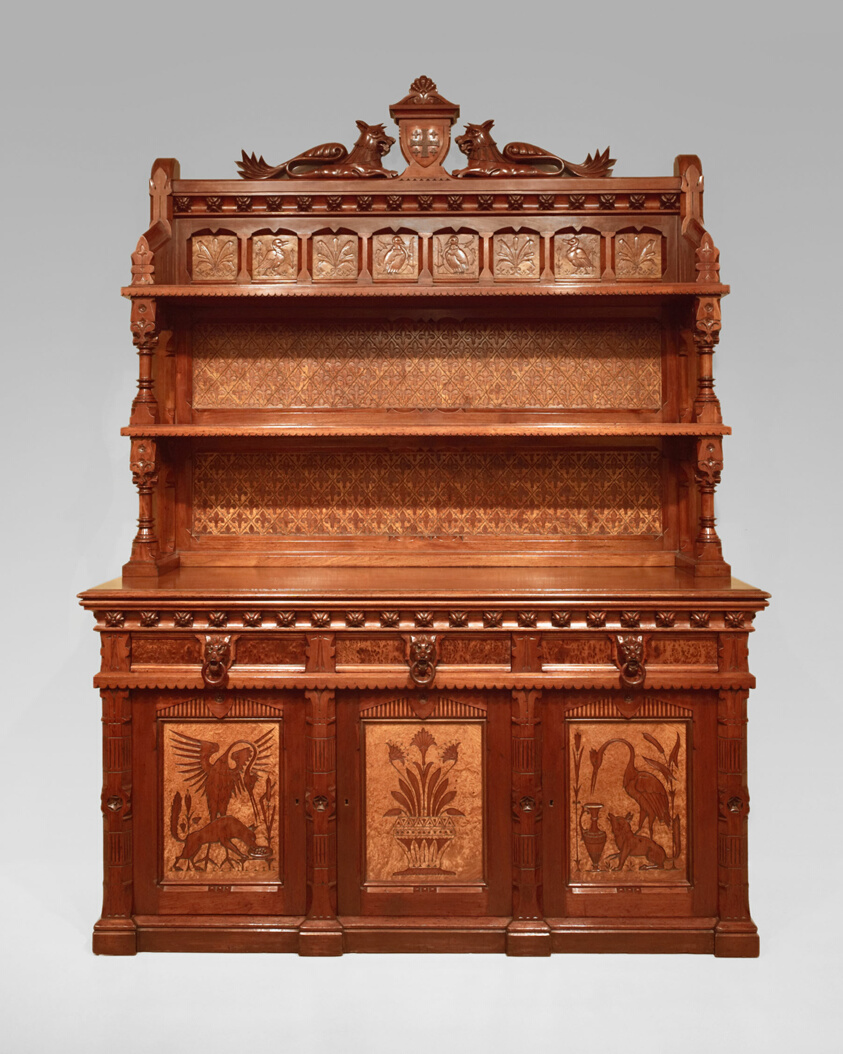
Sideboard
Daniel Pabst (American, 1826–1910)LinkedCulture matchlcp-b8c563031daf
- Date
- 1868–80
- Medium
- Walnut and burled elm
- Culture
- Philadelphia
- Department
- Arts of the Americas
- Institution
- Art Institute of Chicago
- Object ID
- 184672
From the Art Institute of Chicago record
Marking the height of the “modern Gothic” style in Philadelphia, this sideboard resembles the furniture designed by notable architect Frank Furness, who frequently collaborated with cabinetmaker Daniel Pabst. Although details of the piece’s carving tie it unmistakably to Pabst, the design cannot be attributed conclusively to a particular hand. The designer was influenced by the writings of Christopher Dresser and Charles Eastlake, British reformers who advocated honesty of construction and conventionalized ornament. Instead of carving the decoration deeply in order to achieve a naturalistic effect, Pabst used a cameo technique, cutting through the burled elm veneer to reveal the darker walnut beneath and creating a striking color contrast and flattened style of decoration. In the mid-nineteenth century, dining-room furniture typically featured ornament that was intended to reinforce ideals of hospitality and gentility. Here the cabinet doors display designs recounting Aesop’s fable of the fox and the stork, a tale in which each animal offers the other some food in a serving dish from which the guest cannot eat, thus proving the importance of true hospitality. The panels are virtually identical to images found on curtain designs illustrated in Eastlake’s 1868 book Hints on Household Taste , a text that was widely influential in the United States.
The authoritative record is held by Art Institute of Chicago. LinkedCulture surfaces this object and its connections; it does not alter institutional metadata.
Get printable QR codesHide QR codes
Open QR codes for this object page and the museum record. They stay collapsed until needed.
Provenance & credit
As published by the source institution. Coverage varies — not every institution's open-data feed includes ownership history.
- Credit line
- Gift of the Antiquarian Society
Linked open data
Authority identifiers that link this record into the wider web of cultural data — stable references you can follow to the source.
- Object type
- AAT300037336
Related across collections
Semantically similar works from Art Institute of Chicago and other institutions.