Art Institute of Chicago
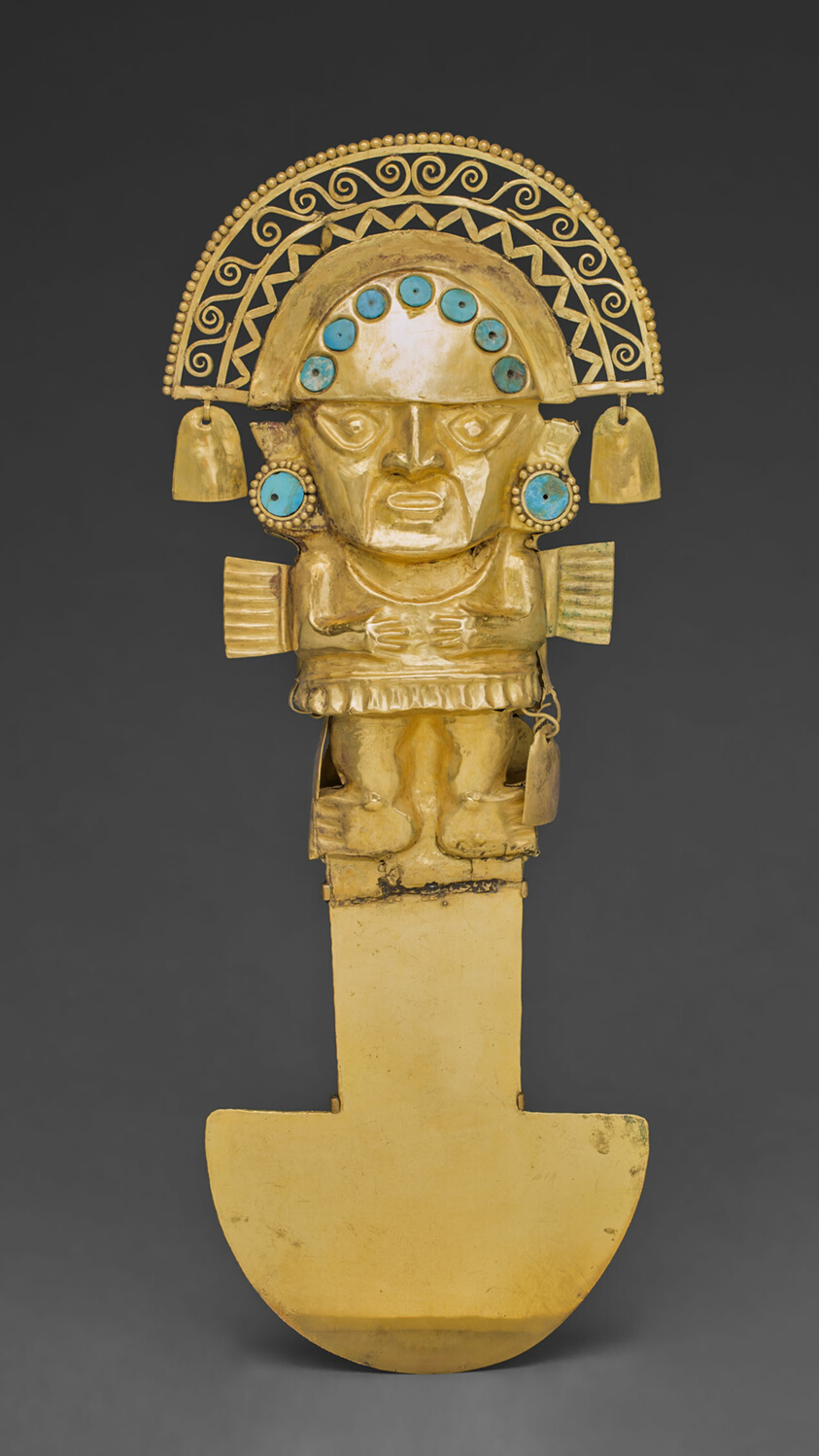
Ceremonial Knife (Tumi)
ChimúLinkedCulture matchlcp-4791f14dd6df
- Date
- 1100–1470
- Medium
- Gold with turquoise inlay
- Culture
- Lambayeque Valley
- Department
- Arts of the Americas
- Institution
- Art Institute of Chicago
- Object ID
- 18757
From the Art Institute of Chicago record
Naymlap, the heroic founder-colonizer of the Lambayque Valley on the north coast of Peru, is thought to be the legendary figure represented on the top of this striking gold tumi (ceremonial knife). It would have been carried by dynastic rulers during state ceremonies to represent, in a more precious form, the copper knives used for animal sacrifices. Here Naymlap stands with his arms to his abdomen and his feet splayed outward. His gold headdress has an elaborate open filigree design. Turquoise—for the peoples of ancient Peru, a precious gem related to the worship of water and sky—is inlaid around the headdress cap and in the ear ornaments. The tumi was made with diverse metalworking techniques. Solid casting was used to produce the blade. The face and body were created with annealing (heating, shaping, and then cooling) and repoussé, in which the relief design is hammered into a mold from the reverse side. Finally, the small ornaments around the top of the headdress were separately hammered or cast, then soldered into place. This tumi and many other gold, silver, and textile objects were made in royal workshops and ceremonially presented to high officials as emblems of rank and authority.
The authoritative record is held by Art Institute of Chicago. LinkedCulture surfaces this object and its connections; it does not alter institutional metadata.
Get printable QR codesHide QR codes
Open QR codes for this object page and the museum record. They stay collapsed until needed.
Provenance & credit
As published by the source institution. Coverage varies — not every institution's open-data feed includes ownership history.
- Credit line
- Ada Turnbull Hertle Endowment
- Provenance
- Everett D. Rassiga (1922-2003), New York, by 1963 [incoming receipt, RX4446, copy in curatorial object file]; sold to the Art Institute of Chicago, 1963.
Linked open data
Authority identifiers that link this record into the wider web of cultural data — stable references you can follow to the source.
- Object type
- AAT300411548
Part of a LinkedCulture topic
 Pre-Columbian Body Adornment
These objects are personal ornaments and jewelry worn by ancient Mesoamerican and Andean cultures, including ear ornaments, nose ornaments, plaques, and costume decorations made from precious metals, stone, shell, and ce
359 objects from 4 institutions
Related across collections
Semantically similar works from Art Institute of Chicago and other institutions.