Art Institute of Chicago
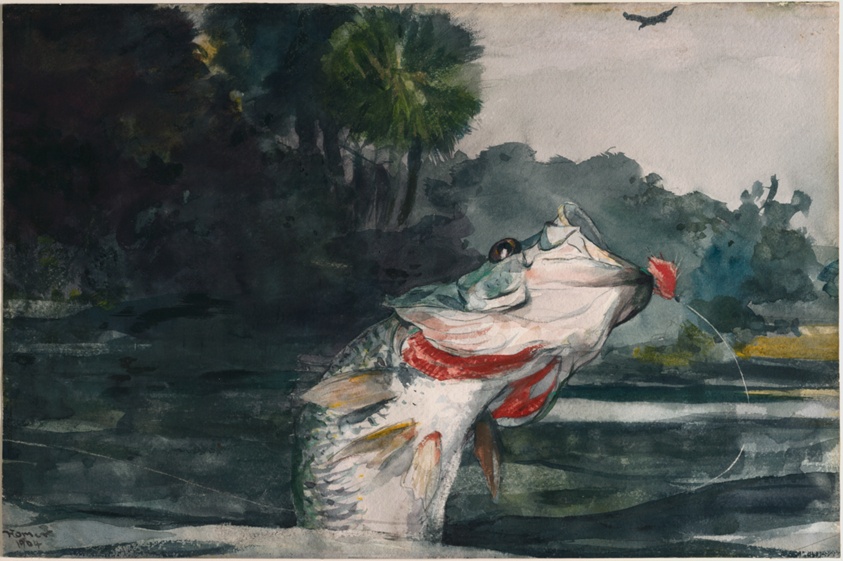
Life-Size Black Bass
Winslow HomerLinkedCulture matchlcp-bcddaaacf48f
- Date
- 1904
- Medium
- Transparent watercolor, with touches of opaque watercolor, rewetting, blotting and scraping, over graphite, on thick, moderately textured (twill texture on verso), ivory wove paper (left, right and lower edges trimmed)
- Culture
- United States
- Department
- Prints and Drawings
- Institution
- Art Institute of Chicago
- Object ID
- 189152
From the Art Institute of Chicago record
In January 1904, Homer traveled to Homosassa, Florida, to fish. The Homosassa River, on the gulf side of the state, was home to many fish species and supported a lush wildlife habitat. It was in Homosassa that Homer painted his final tropical watercolors, including Life-Size Black Bass . In this work, the artist placed the underside of the huge, brightly colored fish at center and close to the viewer, bringing alive the drama, immediacy, and excitement of the fisherman’s experience as his fly, a “scarlet ibis,” hangs in the air. With trademark ambiguity, Homer presented the bass suspended between life and death. Will it succeed in grabbing its bright target only to seal its fate? The fish’s sudden jump slices through the dark, quiet jungle with a momentary flash of life and color. In order to force the viewer into the path of the leaping fish, Homer cropped three centimeters off the lower edge of Life-Size Black Bass . He then centered and framed the fish for maximum effect by trimming a total of 2 centimeters from the right and left edges. The sheet dimensions are 350 x 526 millimeters; the original sheet dimensions were 380 x 545 millimeters as compared with uncut sheets of the same paper type. The trimmed edges appear slightly uneven and lack any adhesive residue from the watercolor paper block. As in a photograph with a short focal length, Homer presented the fish in tight focus against a vague and fluid background. With these compositional choices Homers heightened the tension of the strong, vital bass, frozen in motion, before capture and death. Such dramatic psychological impact results from Homer's three decades of persistent observation using watercolor to transcribe nature on paper.
The authoritative record is held by Art Institute of Chicago. LinkedCulture surfaces this object and its connections; it does not alter institutional metadata.
Get printable QR codesHide QR codes
Open QR codes for this object page and the museum record. They stay collapsed until needed.
Provenance & credit
As published by the source institution. Coverage varies — not every institution's open-data feed includes ownership history.
- Credit line
- Bequest of Brooks McCormick
- Provenance
- Charles Deering (1852-1927) and Mrs. Charles Deering (née Marion Denison Whipple; c. 1857-1943), Chicago, by 1932 [Bolton 1932]. By descent to their daughter, Mrs. Chauncey McCormick (née Marion Deering; 1886-1965), Chicago. By descent to her son, Brooks McCormick (1917-2006), Chicago.
Linked open data
Authority identifiers that link this record into the wider web of cultural data — stable references you can follow to the source.
- Object type
- AAT300033973
Part of a LinkedCulture topic
 American Watercolor Landscape Art
These objects are predominantly watercolor and drawing works by American artists depicting natural landscapes, outdoor recreational activities, and coastal or wilderness scenes from the 19th century.
63 objects from 3 institutions
Related across collections
Semantically similar works from Art Institute of Chicago and other institutions.