Art Institute of Chicago
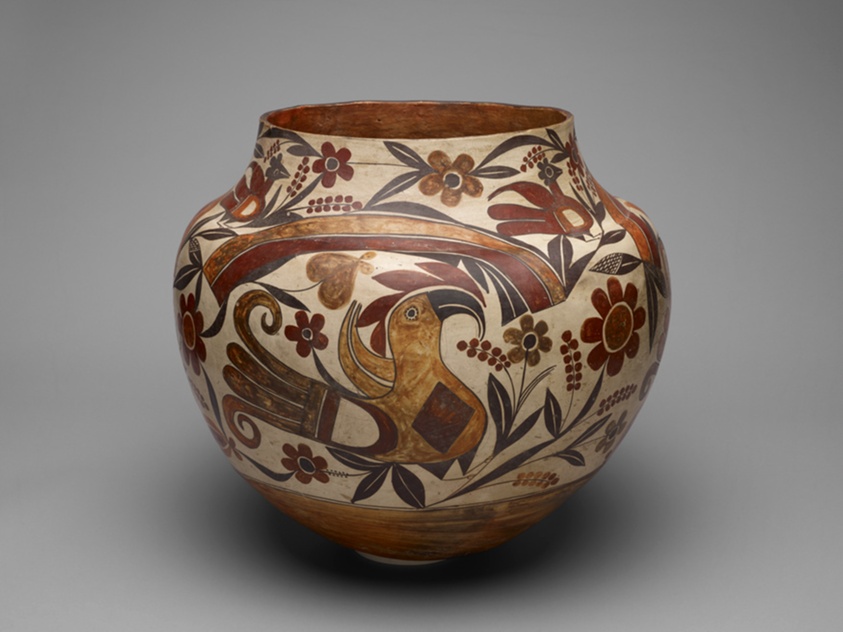
Parrot Olla
Ceramist unknown (Acoma)LinkedCulture matchlcp-bd1bf4c02d5e
- Date
- c. 1880s
- Medium
- Earthenware and slip
- Culture
- Pueblo of Acoma
- Department
- Arts of the Americas
- Institution
- Art Institute of Chicago
- Object ID
- 189293
From the Art Institute of Chicago record
In the American Southwest, there is an Indian ceramic tradition that began to take form in the early centuries A.D. and has continued unbroken to the present time. Characterized by its many superbly varied styles, the art has been sustained by diverse Pueblo peoples and some of their neighbors, whose ancient and more recent settlements have long been established in the arid regions of Arizona and New Mexico. Ceramic artists of the Acoma Pueblo, west of Albuquerque, produced an especially distinguished series of vessels during the late nineteenth and early twentieth centuries. This large, rounded, and beautifully proportioned vessel is covered by exuberant, colorful figures representing macaws and other birds, double rainbows, flowers, and plants. The fluid, lively pattern breaks from the disciplined, abstract symmetry that widely prevails in Puebloan tradition, possibly reflecting the influence of designs from Mexico or perhaps the printed or embroidered textiles from the eastern United States that reached New Mexico beginning in the mid-nineteenth century. Nevertheless, traditional indigenous perceptions remained in play, for macaws have been featured for centuries in Puebloan rituals devoted to the sun, rain, and agricultural fertility, as shown in corresponding ceramic and mural imagery. In this context the rainbows, flowers, and the sense of thriving life also faithfully adhere to an ancient and ongoing theme of communal participation in nature's eternal renewal.
The authoritative record is held by Art Institute of Chicago. LinkedCulture surfaces this object and its connections; it does not alter institutional metadata.
Get printable QR codesHide QR codes
Open QR codes for this object page and the museum record. They stay collapsed until needed.
Provenance & credit
As published by the source institution. Coverage varies — not every institution's open-data feed includes ownership history.
- Credit line
- Ethel T. Scarborough and Major Acquisitions funds; Gladys N. Anderson Endowment Fund
- Provenance
- The artist, Pueblo of Acoma, NM, by 1901; sold to Henry G. Peabody (1855–1951), Pasadena, CA, c. 1902 [undated description of visit to Acoma by H. Peabody; Andrews 1965; Howard 1976; Harlow and Silverman 2005; copies in curatorial object file]. Richard M. Howard, Santa Fe, by 1976 to at least 1998 [Howard 1976; McCoy 1998]. Raymond Dewey, Dewey Galleries, Santa Fe, by 2001 [according to email from J. Silverman, May 18, 2013; copy in curatorial object file]; sold to Jack Silverman, Silverman Museum Collection, Aspen, CO, and Santa Fe, by 2001 [Harlow and Silverman 2001]; sold, Bonhams and Butterfields, San Francisco, CA, Dec. 4, 2006, lot 4008, to the Art Institute of Chicago.
Linked open data
Authority identifiers that link this record into the wider web of cultural data — stable references you can follow to the source.
- Object type
- AAT300386308
Related across collections
Semantically similar works from Art Institute of Chicago and other institutions.