Art Institute of Chicago
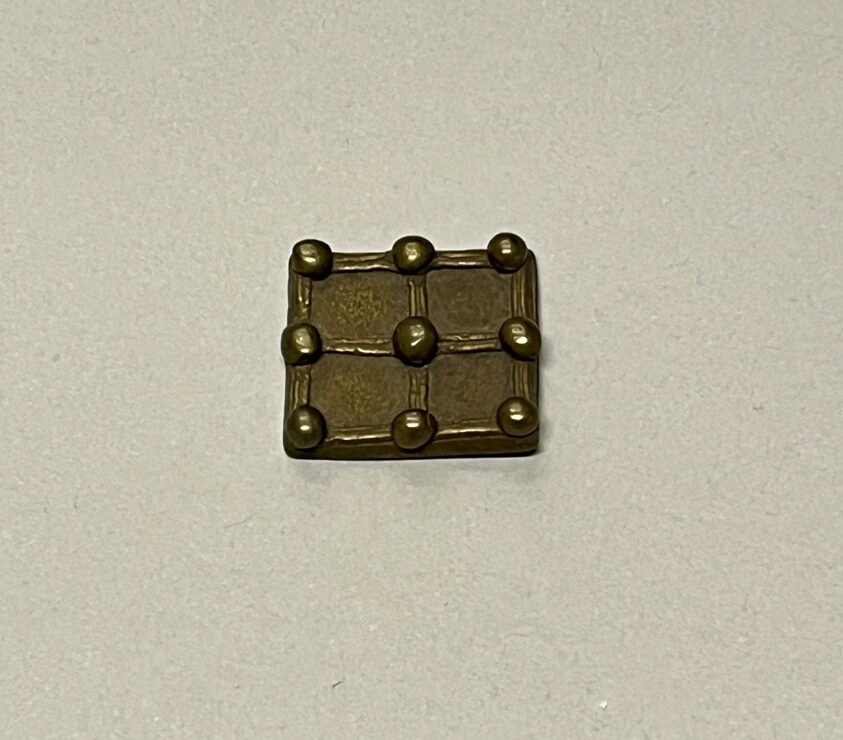
Goldweight with a Geometric Pattern
Asante or related Akan-speaking peoplesLinkedCulture matchlcp-0fe307805012
- Date
- 18th/19th century
- Medium
- Copper alloy
- Culture
- Ghana
- Department
- Arts of Africa
- Institution
- Art Institute of Chicago
- Object ID
- 193099
From the Art Institute of Chicago record
Weights for measuring gold dust were made and used throughout Ghana and Côte d’Ivoire for more than five centuries, from about 1400 to 1900. These weights are either figurative or abstract and are usually divided into an early period (c. 1400–1700) and a late period (c. 1700–1900). During the late period, an increased variety and number of figurative weights emerged, although abstract weights continued to be made. Around the late 14th century, gold mined in the Akan forest regions began to be traded northward—first to the centers of the West African Sahel and then across the Sahara to North Africa. In order to carry out this trade more efficiently, the Akan created two series of weights, one based on the Islamic ounce and one based on the miskal of gold dust. Other weights were later devised for trade with the Portuguese in the late 15th century and then with the Dutch after 1600 This rectangular gold weight’s surface consists of a simple grid traced with two tight parallel lines into four matrixes. The dynamic yet symmetrical design is enhanced by the addition of nine raised domed forms, intersecting each point along the grid.
The authoritative record is held by Art Institute of Chicago. LinkedCulture surfaces this object and its connections; it does not alter institutional metadata.
Get printable QR codesHide QR codes
Open QR codes for this object page and the museum record. They stay collapsed until needed.
Provenance & credit
As published by the source institution. Coverage varies — not every institution's open-data feed includes ownership history.
- Credit line
- Gift of Muriel Kallis Newman
- Provenance
- Muriel Kallis Newman (died 2008), Chicago, Ill., by 1980; given to the Art Institute, 2007.
Linked open data
Authority identifiers that link this record into the wider web of cultural data — stable references you can follow to the source.
- Object type
- AAT300411641
Related across collections
Semantically similar works from Art Institute of Chicago and other institutions.