Art Institute of Chicago
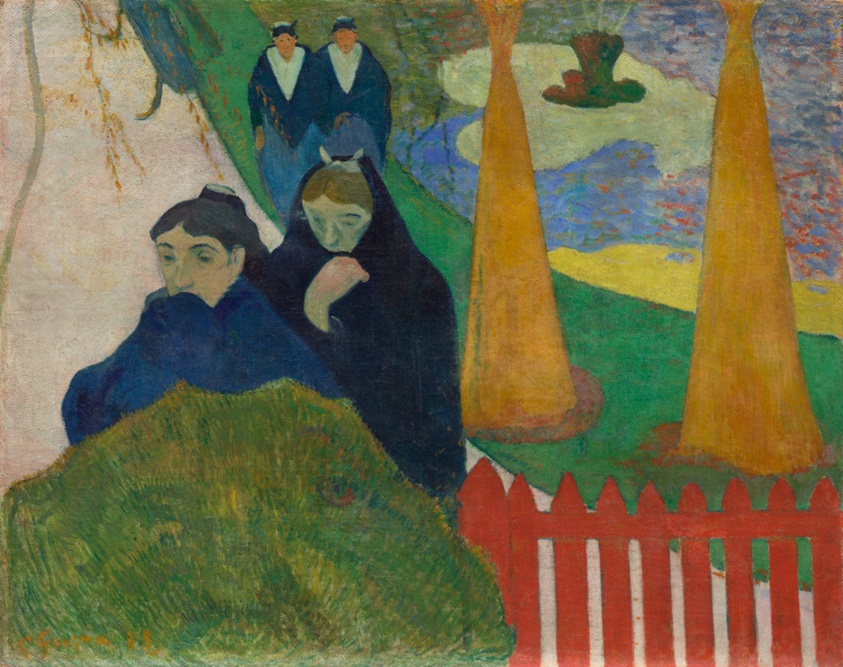
Arlésiennes (Mistral)
Paul Gauguin (French, 1848–1903)LinkedCulture matchlcp-3ef41a0a155c
- Date
- 1888
- Medium
- Oil on jute canvas
- Culture
- France
- Department
- Painting and Sculpture of Europe
- Institution
- Art Institute of Chicago
- Object ID
- 19339
From the Art Institute of Chicago record
During the winter of 1888, Paul Gauguin spent a troubled two months with Vincent van Gogh in the southern French city of Arles. He painted the enigmatic Arlésiennes (Mistral) during this stay. The painters’ time together was intended to be the beginning of an artist’s colony, but their relationship grew increasingly tense, and Van Gogh’s mental health deteriorated. Set directly across the street from the house they shared, the painting depicts four women somberly processing through a public garden. The space is tilted radically upward, and complex, three-dimensional forms are reduced to simple, flat shapes. For example, twin orange-yellow cones—probably protective hay coverings to shield plants from the frost—tower at the right like abstracted human figures. Wrapped in dark shawls, the two closest women cover their mouths against the frigid air. Their gestures are withdrawn and introspective, and their passage is seemingly blocked by a bright red fence and large green bush. Perhaps the composition’s oddest element is the appearance of a face within the bush. This face—an intentional inclusion by the artist—adds an uncanny, watchful presence to the scene. It exemplifies Gauguin’s exploration of what he believed to be the mysteries that suffuse everyday life.
The authoritative record is held by Art Institute of Chicago. LinkedCulture surfaces this object and its connections; it does not alter institutional metadata.
Get printable QR codesHide QR codes
Open QR codes for this object page and the museum record. They stay collapsed until needed.
Provenance & credit
As published by the source institution. Coverage varies — not every institution's open-data feed includes ownership history.
- Credit line
- Mr. and Mrs. Lewis Larned Coburn Memorial Collection
- Provenance
- Sold by the artist to Théo van Gogh for 300 Francs probably in the first half of 1889 [according to "carnet de l'artiste," 1888-1889, see Huyghe 1952, p. 223]; Émile Schuffenecker [according to Jeanne Schuffenecker, see Wildenstein 2001]; Thannhauser Galerie, Lucerne, c. 1923, stock no. 1167 [according to Wildenstein 2001]. James W. Barney, New York, c. 1929 [according to New York 1929 exh. cat.]. De Hauke and Co., New York, 1930 [according to Providence, R. I. 1930 exh. cat.]. Jacques Seligmann and Co., New York by 1931 [according to St. Louis 1931 exh. cat.; De Hauke and Seligmann may have owned the picture together since they were partners until about 1931]; sold to the Art Institute, October 26, 1934, using funds from the Mr. and Mrs. Lewis Larned Coburn Fund.
Linked open data
Authority identifiers that link this record into the wider web of cultural data — stable references you can follow to the source.
- Object type
- AAT300033618
Related across collections
Semantically similar works from Art Institute of Chicago and other institutions.