Art Institute of Chicago
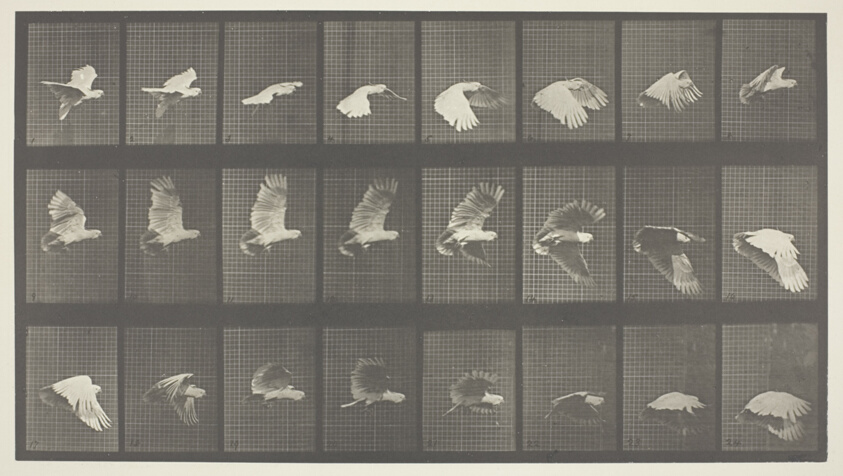
Animal Locomotion, Plate 758
Eadweard Muybridge
- Date
- 1887
- Medium
- Collotype, from "Animal Locomotion"
- Culture
- England
- Department
- Photography and Media
- Institution
- Art Institute of Chicago
In the late 1870s, Eadweard Muybridge pioneered a method of "instantaneous photography," a technique developed to freeze time by capturing motion. In order to create such sequences, he set up a battery of cameras, 24 in this instance, connected by a clockwork mechanism that triggered the shutters one by one at rhythmic intervals. Muybridge initially devised this process to clarify the movement of horses; through his experiments, he demonstrated that all four hooves leave the ground mid-gallop, thereby settling an intense debate of the era. This print of a cockatoo in flight was originally published in Animal Locomotion , a portfolio of 781 separate series that Muybridge, working under the auspices of the University of Pennsylvania, created to stand at the intersection of art and science.
The authoritative record is held by Art Institute of Chicago. LinkedCulture surfaces this object and its connections; it does not alter institutional metadata.
Linked open data
Authority identifiers that link this record into the wider web of cultural data — stable references you can follow to the source.
- Object type
- AAT300046300
Related across collections
Semantically similar works from Art Institute of Chicago and other institutions.
Animal Locomotion, Plate 535
Art Institute of Chicago

Animal Locomotion Plate 167
Minneapolis Institute of Art

The Attitudes of Animals in Motion
Getty Museum

Running (Galloping)
Getty Museum

Running (Galloping)
Getty Museum
Emptying a Bucket of Water
Cleveland Museum of Art
Animal Locomotion, Plate 174
Art Institute of Chicago
Animal Locomotion, Plate 319
Art Institute of Chicago

Animal Locomotion
Getty Museum
Animal Locomotion, Plate 469
Art Institute of Chicago

Animal Locomotion
Getty Museum

Animal Locomotion
Getty Museum