Art Institute of Chicago
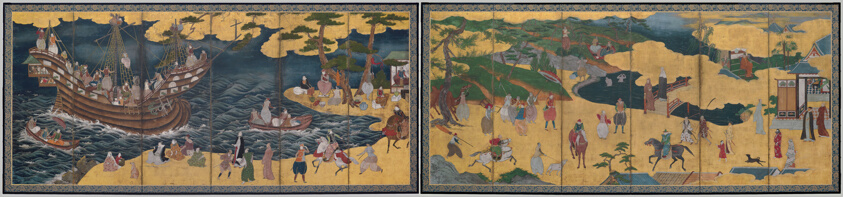
Southern Barbarians
Artist unknown
- Date
- mid 17th century
- Medium
- Pair of six-panel screens; ink, colors, and gold on paper
- Culture
- Japan
- Department
- Arts of Asia
- Institution
- Art Institute of Chicago
一隻の巨大なポルトガルの商船が、船員を満載し、今にも長崎港に入ろうとしている。一方、陸では、現地の人々と西洋人たちが皆一様に到着を待ち構えている。その後、右隻で描かれるように、異国人たちは、町へ向かい、宣教師を含んだ同朋の人々が作った居留地を訪れようとしている。 このようなポルトガル人の日本上陸と活動を描いた屏風は、南蛮屏風と呼ばれる。「南蛮」という語は、ポルトガル人が、マレー半島のマラッカの貿易拠点など東南アジアより航行してきたことに由来する。 屏風は、祭礼や外交使節の行列と到着などを視覚的に詳しく記録する手段であった。南蛮人の一大場面を引き立てるため、画中のポルトガル人は、かなり奇異なる存在に描かれている。当初の南蛮屏風は、実際の出来事に触発されて描かれたかもしれないが、大半の作品は、シカゴ美術館の作品のように、必ずしも特定の出来事を描いたものでないことを留意すべきである。 A large Portuguese trading ship ( nao ) with a full crew draws near to land, about to dock as locals and Westerners alike await its arrival at the port of Nagasaki on Japan’s southernmost island of Kyushu. Later, as depicted on the right screen, the foreigners have made their way into town and are about to call at the settlement set up there by their fellow countrymen, many of whom were Christian missionaries. Such screens—presenting the arrival and activity of the Portuguese in Japan—are known as namban (southern barbarian) screens, the term applied to these visitors ever since they first came to Japan from their Southeast Asian trading bases, some as far away as Malacca on the Malay Peninsula. Because screens were the primary way to record the visual details of festivals, processions, and the arrival of foreign envoys, and to celebrate their pageantry, it is therefore not unusual that the screen format would have been preferred to depict the wondrous presence of the Portuguese. Although the namban screen genre may have been initially inspired by actual events, it should be stressed that most screens of this subject, like the Art Institute works, do not necessarily depict specific events.
The authoritative record is held by Art Institute of Chicago. LinkedCulture surfaces this object and its connections; it does not alter institutional metadata.
Linked open data
Authority identifiers that link this record into the wider web of cultural data — stable references you can follow to the source.
- Object type
- AAT300037336
Related across collections
Semantically similar works from Art Institute of Chicago and other institutions.
Society for the Picturing of Famous Places on the Kiso Road (Kisoji meisho zukai ichikan)
Harvard Art Museums
Bivak van Kozakken bij vuur tijdens Franse bezetting in 1813 te Amsterdam
Rijksmuseum
Iconographic Drawing of the North Star or Sudarsana Mandala (Myoken mandara), attributed to Gensho
Harvard Art Museums
Sint Joris en de draak
Rijksmuseum
Allons bon!... voila les Gafignons qui viennent à six de Paris... / 18
Musée Carnavalet, Histoire de Paris
Hesione Is Offered by Her Father Laomedon to a Sea Monster
Harvard Art Museums

Vuë du côté de St Victor. / 16. / Vuë des Environs de Bercy. / 20. / Vuë des Environs de Fontainebleau. / 19.
Musée Carnavalet, Histoire de Paris
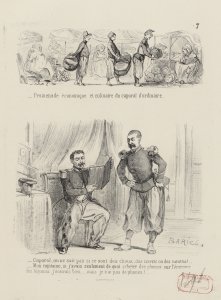
Promenade économique et culinaire du caporal d'ordinaire.
Musée Carnavalet, Histoire de Paris
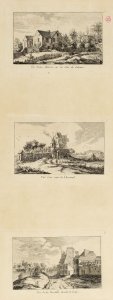
Vuë d'une maison sur les côtés du Calvaire. / 15. / Vuë d'un coin de l'Arsenal. / 6. / Vue de la Bastille du côté de l'eau. / 9.
Musée Carnavalet, Histoire de Paris
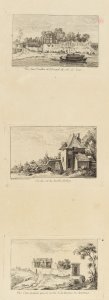
Vue d'un Pavillon de l'Arsenal du côté de l'eau. / Vuë du côté du Jardin du Roy. / Vue d'une maison qui est à côté de la Barrière des Chartreux. / 3.
Musée Carnavalet, Histoire de Paris

Soldats serbes embarquant sur un navire
Musée Carnavalet, Histoire de Paris
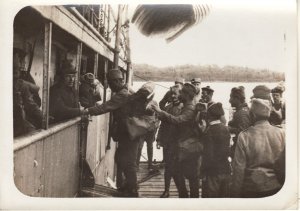
Soldats serbes embarquant sur un navire
Musée Carnavalet, Histoire de Paris