Art Institute of Chicago
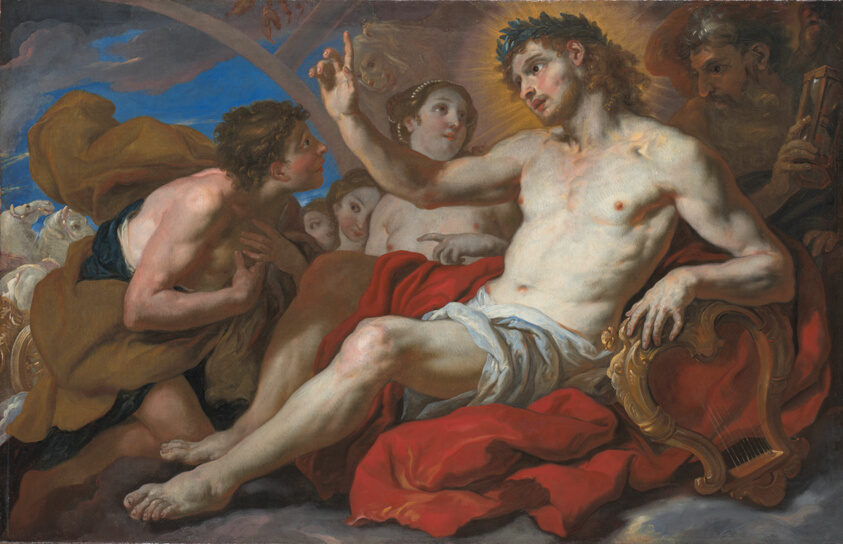
Apollo Granting Phaeton Permission to Drive the Chariot of the Sun
Johann Michael Rottmayr (Austrian, 1654–1730)LinkedCulture matchlcp-9c64d6849524
- Date
- c. 1695
- Medium
- Oil on canvas
- Culture
- Austria
- Department
- Painting and Sculpture of Europe
- Institution
- Art Institute of Chicago
- Object ID
- 20155
From the Art Institute of Chicago record
There may have been seven mythological paintings in this series , each corresponding to a celestial body and a day of the week. In the 17th century, the cosmological correlations between the movements of the planets and the passing of time were demonstrated through stories like this one. Here, Apollo, the Roman sun god of Sunday, grants his pleading son Phaeton permission to drive his chariot, a journey that would bring the light of day across the sky. Apollo’s daughters, the Heliades, and Chronos, the god of time, look on with interest. Phaeton, a human, would ultimately crash and set the earth ablaze.
The authoritative record is held by Art Institute of Chicago. LinkedCulture surfaces this object and its connections; it does not alter institutional metadata.
Get printable QR codesHide QR codes
Open QR codes for this object page and the museum record. They stay collapsed until needed.
Provenance & credit
As published by the source institution. Coverage varies — not every institution's open-data feed includes ownership history.
- Credit line
- Gift of Jacob S. Sherman
- Provenance
- Unknown Illinois banker; given by banker to Jacob S. Sherman, Chicago, during the 1930s as collateral for a loan that was never repaid [according to Robert Parker Sherman, son of Jacob S. Sherman, telephone conversation with Martha Wolff, 23 July 2003, transcribed in curatorial file]; bequeathed by Jacob S. Sherman (died 1961) to the Art Institute, 1961.
Linked open data
Authority identifiers that link this record into the wider web of cultural data — stable references you can follow to the source.
- Object type
- AAT300033618
Related across collections
Semantically similar works from Art Institute of Chicago and other institutions.