Art Institute of Chicago
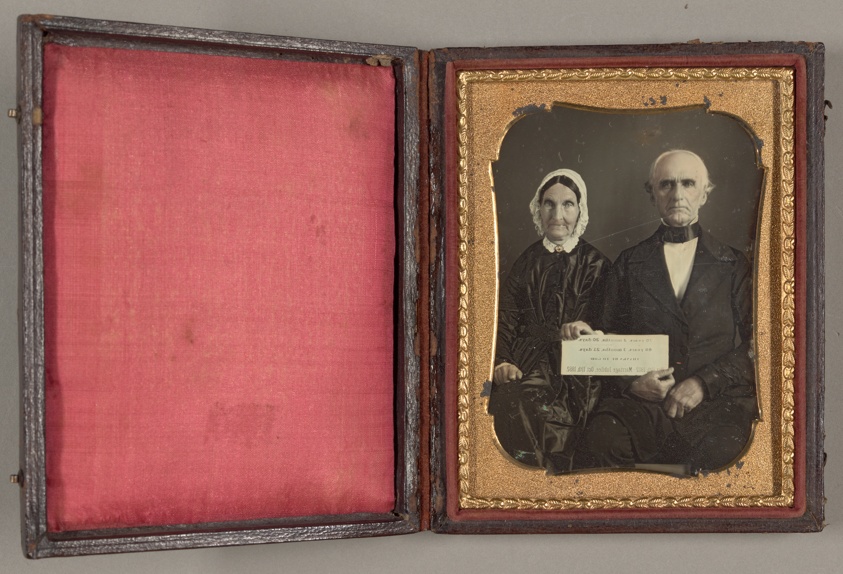
Untitled (Married Couple)
Artist unknownLinkedCulture matchlcp-720adf61c688
- Date
- 1852
- Medium
- Daguerreotype
- Culture
- United States
- Department
- Photography and Media
- Institution
- Art Institute of Chicago
- Object ID
- 207451
From the Art Institute of Chicago record
The daguerreotype was invented in France in 1839 but gained its longest-lived popularity in America, where it was prized for its faithful detail and affordability. In the 1850s especially, millions of daguerreotypes were made by "operators" who rapidly learned the technique—involving copper plates coated in silver, each producing a unique image—to fulfill burgeoning demand for portraits. The seated elderly couple shown here holds a note identifying their ages and the occasion for the image, their 50th wedding anniversary: "70 years, 2 months, 20 days. / 68 years, 3 months, 21 days. / THANKS BE TO GOD: / Oct. 11th, 1802 Marriage Jubilee, Oct. 11th, 1852." Lateral reversal through the camera lens caused all writing in daguerreotypes to appear backwards, while the fineness of the metal plate gave jewel-like precision and great tonal range to the images. These qualities prompted viewers to nickname the daguerreotype "mirror with a memory."
The authoritative record is held by Art Institute of Chicago. LinkedCulture surfaces this object and its connections; it does not alter institutional metadata.
Get printable QR codesHide QR codes
Open QR codes for this object page and the museum record. They stay collapsed until needed.
Provenance & credit
As published by the source institution. Coverage varies — not every institution's open-data feed includes ownership history.
- Credit line
- Gift of The Estate of Carl A. and Helen Pelon Walvoord
Linked open data
Authority identifiers that link this record into the wider web of cultural data — stable references you can follow to the source.
- Object type
- AAT300046300
Related across collections
Semantically similar works from Art Institute of Chicago and other institutions.