Art Institute of Chicago
Tunic
Wari- Date
- 600-800
- Medium
- Cotton and wool (camelid), single interlocking tapestry weave; neck and armholes finished in wool (camelid) in overcast stitches; seams joined with wool (camelid) in darning stitches
- Culture
- Peru
- Department
- Textiles
- Institution
- Art Institute of Chicago
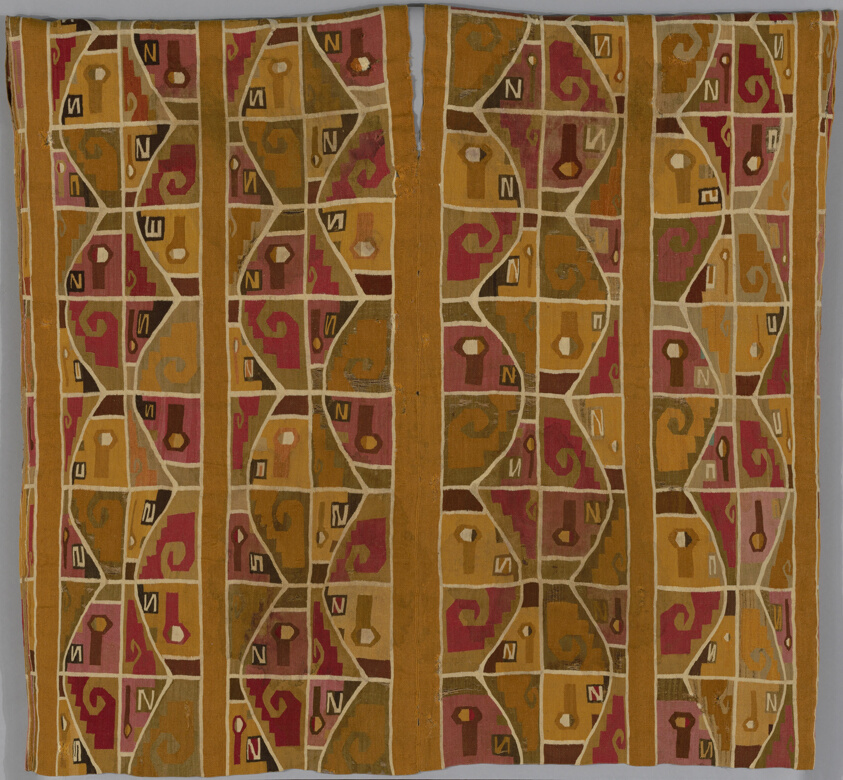
The Wari Empire rose to power near modern-day Ayacucho during the first millennium. Eventually, it came to control much of highland Peru alongside a related state called Tiwanaku in what is now Bolivia. Waris and Tiwanakus developed a shared corpus of imagery that was most elaborately materialized in fine tunics, which were then worn by and buried with elite men. Wari woven designs have some of the highest thread counts of any handwoven fabric made anywhere in the world. The designs on Wari tunics are highly abstract. One side of each motif is a zigzag line that turns into a spiral (a common but unclear Andean symbol), while the other half represents a face in profile. The vertically divided circle is the eye. The N-shaped area represents grimacing canine teeth. The band with two or three dots above or below it represents a hat. While the faces are clearer in the tunics to the left and right, in this fragment the eye is upside-down and the mouth is where the nose should be. Similar to other Wari textiles in the Art Institute's collection (including AIC 1955.1702 , 1955.1784 ), this tunic features motifs comprised of faces and stepped spirals, showing how highly regulated Wari designs were. But the most curious aspect of Wari tunics is how the compositions of the motifs become increasingly compressed on the garments’ sides. Wari tunics also feature color irregularities. In the fourth column, notice the two blue noses of the faces in the fourth and fifth rows. These may have been intentionally created by the weaver or may be the result of fading dyes.
The authoritative record is held by Art Institute of Chicago. LinkedCulture surfaces this object and its connections; it does not alter institutional metadata.
Get printable QR codesHide QR codes
Open QR codes for this object page and the museum record. They stay collapsed until needed.
Linked open data
Authority identifiers that link this record into the wider web of cultural data — stable references you can follow to the source.
- Object type
- AAT300209261
Related across collections
Semantically similar works from Art Institute of Chicago and other institutions.