Art Institute of Chicago
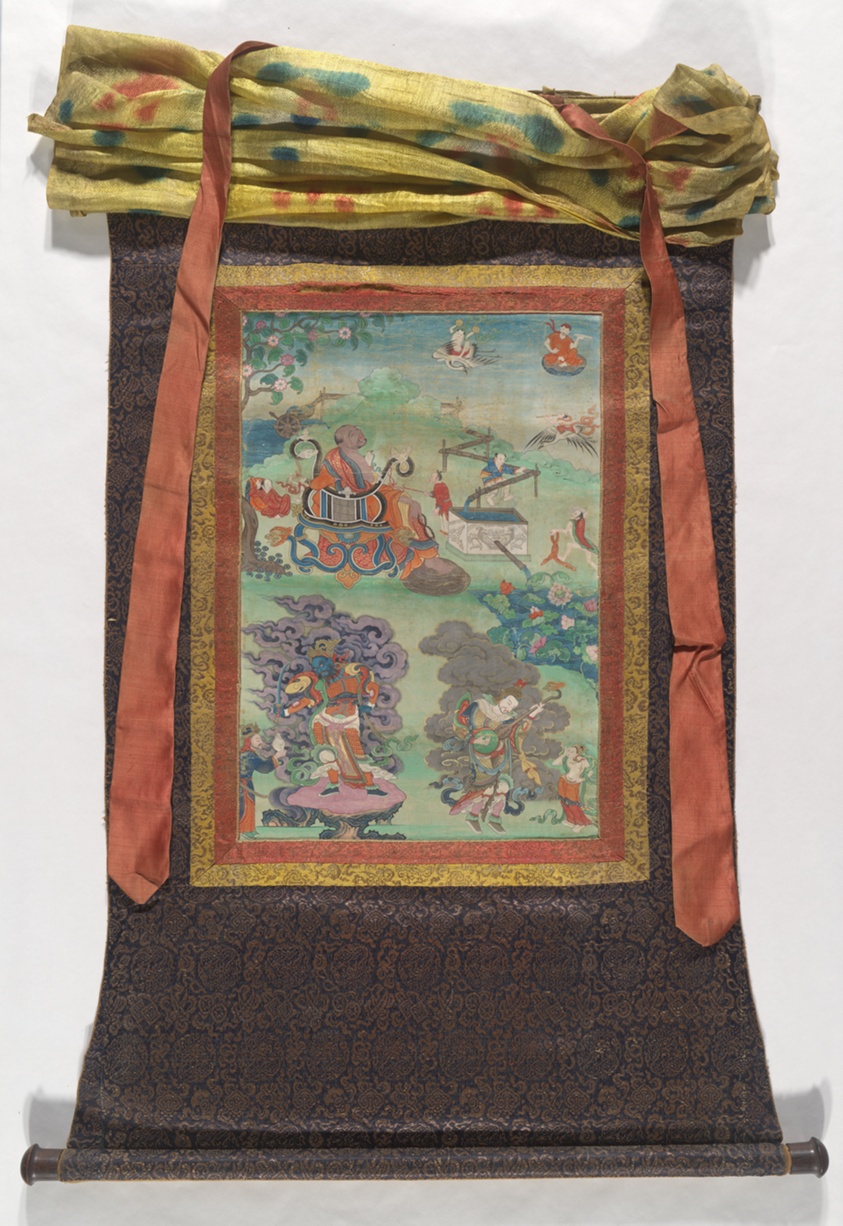
Painted Banner (Thangka) of Hvashang, from a Set of Seven Portraying the Sixteen Arhats (Elders), Early Disciples of the Historical Buddha Shakyamuni
TibetLinkedCulture matchlcp-bb58281fe696
- Date
- 19th century
- Medium
- Pigment on cloth
- Culture
- Tibet
- Department
- Arts of Asia
- Institution
- Art Institute of Chicago
- Object ID
- 218471
From the Art Institute of Chicago record
This thangka features Hvashang, a legendary devotee of the Buddha Shakyamuni. Although his name means “Chinese monk,” he is also identified as the Buddha’s patron, and in Tibetan art he is frequently dressed in lay robes and adorned with jewelry like a merchant. He is also associated with children and often appears, as shown here, surrounded by children at play. Hvashang is one of the additional figures who make up the full iconographic grouping included with representations of Shakyamuni and the sixteen arhats, the subject of the seven thangka set to which this work belongs. Such sets typically contain twenty-five figures in all, centering on Shakyamuni surrounded by his close attendants Shariputra and Maudgalyayana, the sixteen arhats, the four guardian kings who protect the cardinal directions, and the two devotees, Hvashang and Dharmata. Hvashang, like a number of these figures, is generally not worshipped on his own, but collectively the grouping has become a popular subject for both devotional practice and artistic representation. In painting, the group may appear in a single thangka or in sets with one or more figures per thangka. In the present work, Hvashang is accompanied by two of the guardian kings, Dhritarashtra and Virudhaka, guardians of the east and south, respectively. In Chinese Buddhism, some traditions honor a set of eighteen arhats (Chinese: 羅漢; luohan) rather than sixteen, which is achieved by counting Hvashang and the lay supporter Dharmatala in the group as arhats; however, in the Tibetan tradition, they are included but counted separately. The group of seven thangkas to which this work belongs would normally be hung together, placed in a row with a central thangka and three thangkas flanking it on each side. This thangka’s composition and the orientation of the figures directs the viewer’s attention to the right, where the central thangka would normally be placed. The Tibetan inscription on the back of the hanging bar specifies that it is the “third on the right,” indicating that it is to be placed as the third and outermost thangka to the proper right (viewer’s left) of the central thangka (1923.968). The thangkas in this set of seven have been preserved with their traditional cloth mount and protective silk curtain.
The authoritative record is held by Art Institute of Chicago. LinkedCulture surfaces this object and its connections; it does not alter institutional metadata.
Get printable QR codesHide QR codes
Open QR codes for this object page and the museum record. They stay collapsed until needed.
Provenance & credit
As published by the source institution. Coverage varies — not every institution's open-data feed includes ownership history.
- Credit line
- Gift of Emily Crane Chadbourne
- Provenance
- Emily Crane Chadbourne (1871-1964) by 1923; given to the Art Institute of Chicago, August 20, 1923 [copy of original and corrected receipts in the curatorial object file]; accepted by the Trustees, November 6, 1923 [Trustee Minutes vol. 8 meeting of November 6, 1923].
Linked open data
Authority identifiers that link this record into the wider web of cultural data — stable references you can follow to the source.
- Object type
- AAT300033618
Related across collections
Semantically similar works from Art Institute of Chicago and other institutions.