Art Institute of Chicago
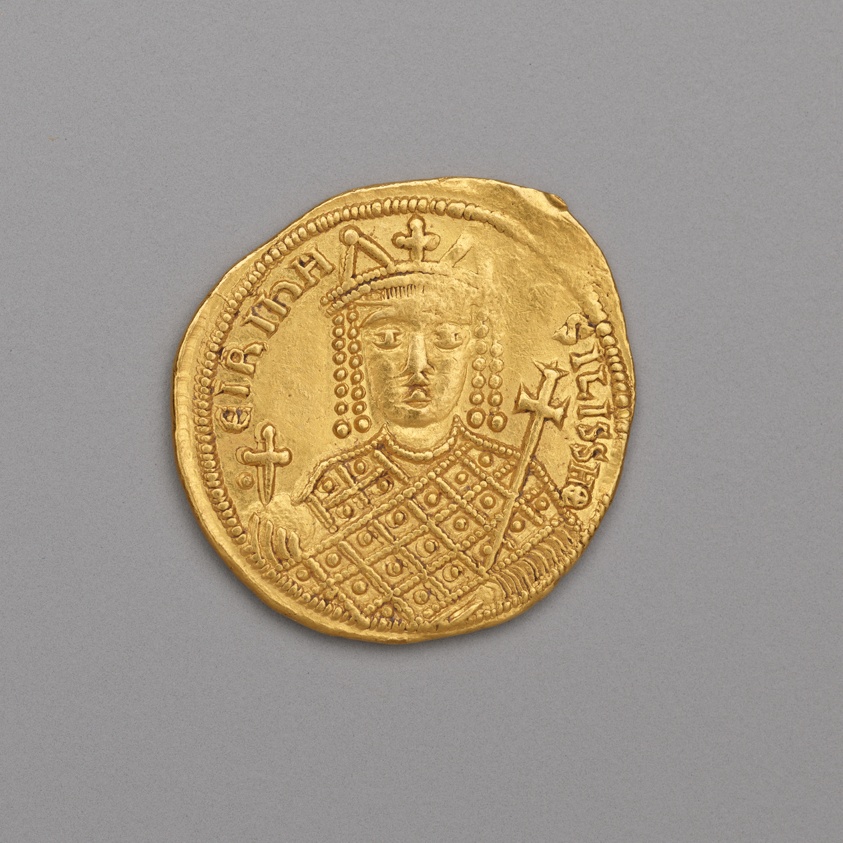
Solidus (Coin) of Empress Irene
Byzantine; minted in Constantinople (now Istanbul, Turkey)LinkedCulture matchlcp-7c5dfd394f33
- Date
- 797-802
- Medium
- Gold
- Culture
- Istanbul
- Department
- Arts of Greece, Rome, and Byzantium
- Institution
- Art Institute of Chicago
- Object ID
- 221685
From the Art Institute of Chicago record
Coins were the ideal way for Byzantine rulers to rapidly circulate their images throughout the empire and beyond, since they were used to pay for imported merchandise and foreign mercenaries. They could also be employed as powerful vehicles for propaganda, promoting messages of dynastic legitimacy and the divine source of the emperor’s right to rule. After Christianity became the official religion of the Roman Empire, the Byzantine emperors adopted Christian themes and symbols, most notably the cross, to stand for both the religion and the political state. The previously ubiquitous profile portrait head of coins of the Roman Empire was replaced by frontal or full-body depictions. Christ dominated the iconography, and Greek titles and phrases came to replace the Latin ones. Irene was one of only three female rulers to hold sole power in the 1,100-year-long history of the Byzantine Empire. This rare coin, minted during her reign, not surprisingly incorporates remarkable iconographical innovations, with every detail stressing her sole imperial authority. She is designated basilissa (empress) in the inscription, the first time this title is present in Byzantine coinage. Her image appears on both sides, representing the first imperial double portrait on a Byzantine coin. She wears a cross-surmounted crown with pendilia (pearl adornments that reach nearly to the shoulders) and a jewel-encrusted loros (a long imperial scarf) and holds in her hands the globus cruciger (cross-topped orb) and cross-topped staff—all signs of male imperial power and dominion over the Christian world. Irene left a notable mark on the male-dominated world of Byzantine politics. She came to power by blinding and exiling her son Constantine VI. Reversing her husband’s policies, she reinstituted icon veneration. Her reign also witnessed the first major challenge from the Christian West, when in the year 800 Charlemagne was crowned Holy Roman Emperor. Irene’s gender was a perceived justifi-cation for this action: a woman could not be a legitimate emperor. This watershed moment initiated a controversy between the rulers of Roman Catholic Europe and those of the Byzantine Empire about rightful claims to imperial authority. Unresolved, the controversy lasted until the end of the Byzantine Empire in 1453.
The authoritative record is held by Art Institute of Chicago. LinkedCulture surfaces this object and its connections; it does not alter institutional metadata.
Get printable QR codesHide QR codes
Open QR codes for this object page and the museum record. They stay collapsed until needed.
Provenance & credit
As published by the source institution. Coverage varies — not every institution's open-data feed includes ownership history.
- Credit line
- Gift of the Classical Art Society
- Provenance
- Dr. John, Gulick, Chapel Hill, N.C. (1924-2012), probably by 1973 [based on numismatics reference numbers, see justification in curatorial file]; with Harlan J. Berk Ltd., Chicago, by 2014; sold to the Art Institute of Chicago, 2014.
Linked open data
Authority identifiers that link this record into the wider web of cultural data — stable references you can follow to the source.
- Object type
- AAT300037334
Related across collections
Semantically similar works from Art Institute of Chicago and other institutions.