Art Institute of Chicago
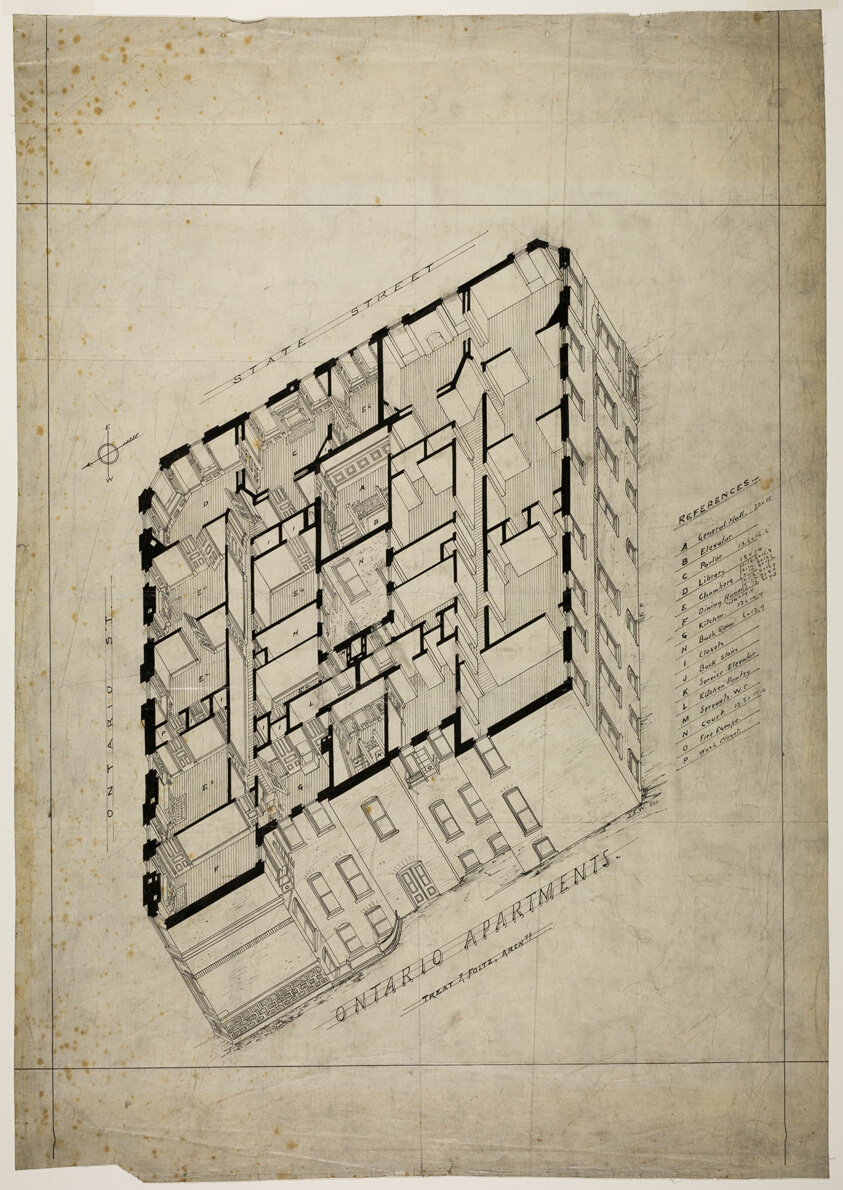
Ontario Apartment Building, Chicago, Illinois, Isometric
Treat and FoltzLinkedCulture matchlcp-d547cb880b3d
- Date
- c. 1880/81
- Medium
- Ink and ink wash on linen
- Culture
- Chicago
- Department
- Architecture and Design
- Institution
- Art Institute of Chicago
- Object ID
- 236924
From the Art Institute of Chicago record
The Ontario Apartments were one of the first multifamily apartment buildings in Chicago catering to a middle- and upper-class clientele. The appearance of such a structure was novel in the then-semirural neighborhood of large houses in what is today the city’s River North neighborhood. Therefore, it was important that the structure conformed to the standards of fine houses, with brick and carved stone construction, decorative ironwork, and offered large apartments equipped with libraries, parlors, and servant rooms. The building was designed to be easily converted to a hotel, a change that was indeed made in 1893 to accommodate visitors to the World’s Columbian Exposition. Treat and Foltz had an active architectural practice in Chicago during the 1880s and 1890s, focusing largely on single-family residences in a range of styles. The large collection of drawings by the firm given to the Burnham Library represents an aspect of Chicago’s architectural history that otherwise would have likely been lost.
The authoritative record is held by Art Institute of Chicago. LinkedCulture surfaces this object and its connections; it does not alter institutional metadata.
Get printable QR codesHide QR codes
Open QR codes for this object page and the museum record. They stay collapsed until needed.
Provenance & credit
As published by the source institution. Coverage varies — not every institution's open-data feed includes ownership history.
- Credit line
- Gift of J. Arthur Scott
Linked open data
Authority identifiers that link this record into the wider web of cultural data — stable references you can follow to the source.
- Object type
- AAT300054197
Related across collections
Semantically similar works from Art Institute of Chicago and other institutions.