Art Institute of Chicago
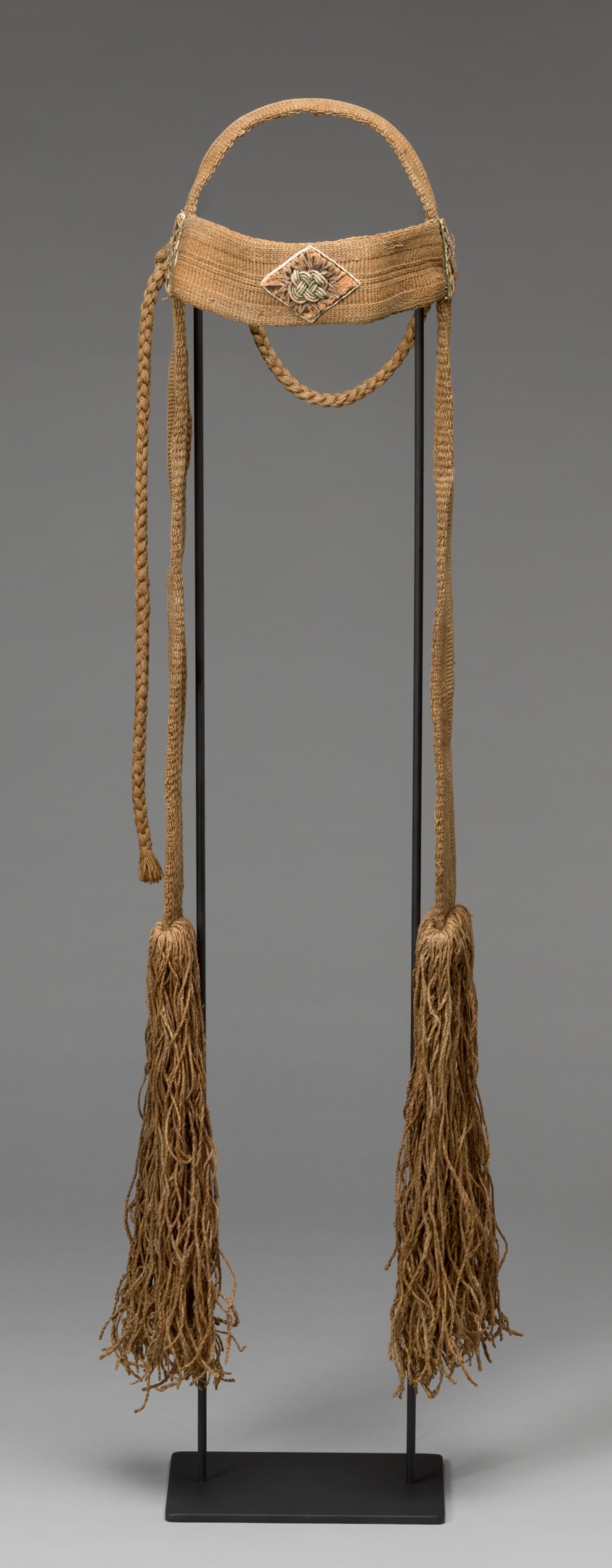
Ceremonial Headdress
AinuLinkedCulture matchlcp-59e14e720834
- Date
- Edo period (1615–1868), first half of the 19th century or earlier
- Medium
- Bast fiber, gilt-paper-wrapped silk, silk, and wood
- Culture
- Hokkaido region
- Department
- Textiles
- Institution
- Art Institute of Chicago
- Object ID
- 238799
From the Art Institute of Chicago record
The Ainu people of northern Japan and eastern Russia are an aboriginal group that maintains a way of life separate from that of the mainstream culture in Japan. They have their own language, religion, and material culture, all of which had been suppressed until the later 20th century—even though anthropologists, ethnographers, and art historians have long been interested in studying and preserving their traditions. The Ainu are best known for their visually striking coats as well as carved and decorated wooden implements and headbands, baskets, mats, and other weavings.
The authoritative record is held by Art Institute of Chicago. LinkedCulture surfaces this object and its connections; it does not alter institutional metadata.
Get printable QR codesHide QR codes
Open QR codes for this object page and the museum record. They stay collapsed until needed.
Provenance & credit
As published by the source institution. Coverage varies — not every institution's open-data feed includes ownership history.
- Credit line
- Purchased with funds provided by the Patrick and Shirley Ryan Family in Honor of Alice Welsh Skilling
- Provenance
- Tim Okamoto, Shibui-Japanese Antiques, Pasadena, CA, probably late 1970s; sold to Paul and Marcia Secord, Albuquerque, NM, early 1980s, sold through John Ruddy Textile Art, Santa Fe, NM [invoice, June 8, 2017; copy in curatorial object file] to the Art Institute of Chicago, 2017.
Linked open data
Authority identifiers that link this record into the wider web of cultural data — stable references you can follow to the source.
- Object type
- AAT300209261
Related across collections
Semantically similar works from Art Institute of Chicago and other institutions.