Art Institute of Chicago
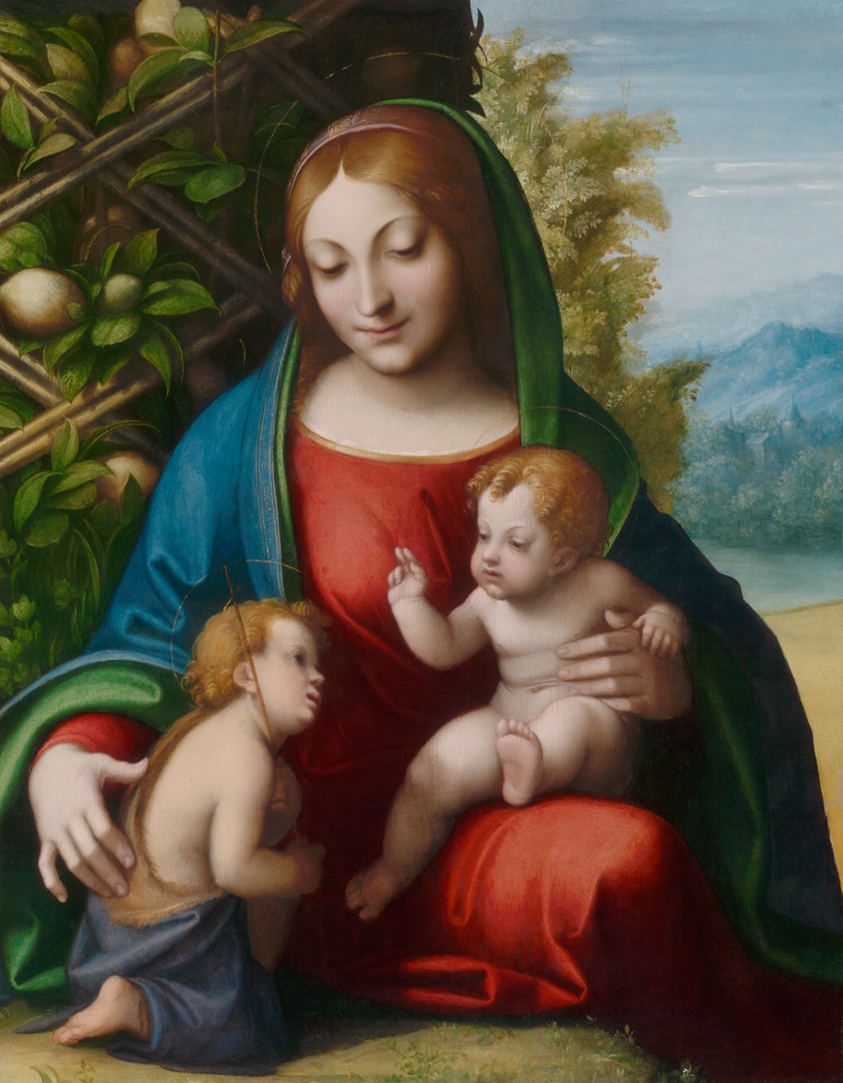
Virgin and Child with the Young Saint John the Baptist
Correggio (Antonio Allegri; Italian, 1489–1534)LinkedCulture matchlcp-5d45777b8a5e
- Date
- c. 1515
- Medium
- Oil on panel
- Culture
- Italy
- Department
- Painting and Sculpture of Europe
- Institution
- Art Institute of Chicago
- Object ID
- 23972
From the Art Institute of Chicago record
In this intimate devotional panel, the young Correggio demonstrated his own evolving style while also assimilating lessons from other great painters of his era. The work’s pyramidal grouping of figures reflects the style of Raphael , while their soft outlines and the Virgin’s enigmatic smile recall the work of Leonardo da Vinci. The landscape in the background adds to the painting’s charm and demonstrates the artist’s knowledge of Northern European precedents. The gentle sensuousness of the figures and the tenderness they show one another, however, are unique to Correggio. The artist used color, light, and shadow to bathe the image in a gentle glow, with skin and fabrics taking on a velvety texture. Correggio lived and worked in the northern Italian city of Parma, executing a body of work that is remarkable for its inventiveness and sophistication given his remove from the artistic centers of Rome, Florence, and Venice. This small panel is in his earliest style, but its idyllic quality presages the radiant ceiling frescoes of Correggio’s maturity, especially those in Parma’s cathedral (1526–30).
The authoritative record is held by Art Institute of Chicago. LinkedCulture surfaces this object and its connections; it does not alter institutional metadata.
Get printable QR codesHide QR codes
Open QR codes for this object page and the museum record. They stay collapsed until needed.
Provenance & credit
As published by the source institution. Coverage varies — not every institution's open-data feed includes ownership history.
- Credit line
- Clyde M. Carr Fund
- Provenance
- Baron Nicholas Massias, Paris, by 1815; sold Laneuville and Lacoste, Paris, December 13 or following, 1825 (originally scheduled for December 14, 1824), no. 27, as Bernardo Luini, for Fr 4,000 [according to Landon 1815, p. 17]. Private collection, Germany [statement from Wildenstein and correspondence of John Maxon, The Art Institute of Chicago Archives; Maxon recounted that the Milanese collector cited below bought the picture sometime around the beginning or end of World War II at an unidentified public auction in Germany as Italian, first quarter of the sixteenth century]. Minari collection, Milan [statement of Wildenstein (without reference to collector's name) and Maxon papers, The Art Institute of Chicago]. Wildenstein, New York; sold to the Art Institute, 1965.
Linked open data
Authority identifiers that link this record into the wider web of cultural data — stable references you can follow to the source.
- Object type
- AAT300033618
Related across collections
Semantically similar works from Art Institute of Chicago and other institutions.