Art Institute of Chicago
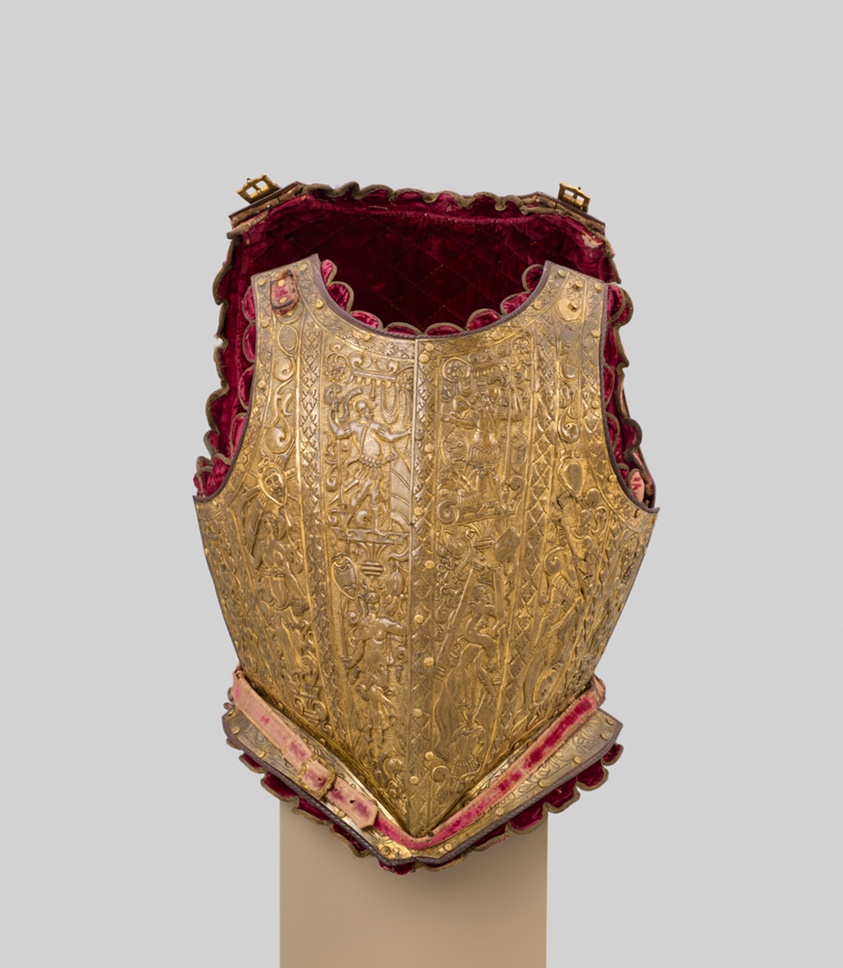
Parade Cuirass
Possibly FranceLinkedCulture matchlcp-37fcb53217da
- Date
- c. 1600–10
- Medium
- Brass, iron, leather, silver-gilt thread, silk and linen textile
- Culture
- France
- Department
- Applied Arts of Europe
- Institution
- Art Institute of Chicago
- Object ID
- 262717
From the Art Institute of Chicago record
This cuirass (beast- and backplate) is the only known example of its kind from the turn of the seventeenth century. Produced from soft sheets of brass embossed from both the inside and out and then gilded, it was likely produced by a goldsmith rather than an armorer. Though in the form of battle-ready armor, the cuirass served no true defensive purpose, instead acting as a conspicuous sign of rank and wealth. Originally, it would have formed part of an ensemble with a burgonet—a type of open-face helmet—and a matching round shield. This garniture would have been worn by a high-ranking nobleman or military commander on festive occasions, processional entries into a city, or other courtly and civic ceremonies. The surface of the cuirass is a riot of attenuated figures and ornament, typical of mannerist taste. The lively, more naïve than elegant mode of the decoration suggests the work of an unidentified provincial Flemish, German, or French goldsmith. Some of the figures are identifiable: from Classical antiquity, Mars and Hercules; from the Old Testament, David and Goliath; and the virtues of Justice, Temperance, Faith, and Hope. The figures are loosely taken from engraved prints by such artists as Maarten van Heemskerck (Netherlandish, 1498–1574), Hans Vredeman De Vries (Dutch, 1527–c. 1606), and Étienne Delaune (French, 1518/19–c. 1583). The shape of the breastplate, with its pronounced high waist and deep V-shaped belly, copies the fashionable “peasecod” doublet, named for mimicking the swelled shape of a peapod. The profile of this cuirass’s belly suggests it was made around 1600.
The authoritative record is held by Art Institute of Chicago. LinkedCulture surfaces this object and its connections; it does not alter institutional metadata.
Get printable QR codesHide QR codes
Open QR codes for this object page and the museum record. They stay collapsed until needed.
Provenance & credit
As published by the source institution. Coverage varies — not every institution's open-data feed includes ownership history.
- Credit line
- Pauline Seip Armstrong Endowment Fund; Harding Collection Fund; purchased with funds provided by Paul Carbone; Bessie Bennett Endowment Fund; Beatrice Swartchild and Laird Landmann Arms and Armor funds; Wendel Fentress Ott and Charles R. and Janice J. Feldstein endowment funds
- Provenance
- Probably anonymous sale, Hotel Drouot, Paris, June 7, 1884, lot 24 . Richards collection before 1890; sold Raoul Richards sale, Rome, March 3, 1890, lot 937 (ill. plate VII). M. A. Lazzaroni collection before 1894; sold M. A. Lazzaroni sale, Rome, December 10-20, lot 591 (ill. plateVIII). Sale, Munich, June 1, 1896, lot 776 (ill.). Possibly in a private collection, Berlin. Sotheby’s, New York, May 10-11, 1985, lot 233; sold to private U.S. collection ; sold at Sotheby's New York, Nov. 25, 1986, lot 505; anonymous public U.S. institution; Thomas Del Mar Ltd., London, Dec. 8, 2021, lot 220; sold to the Art Institute of Chicago.
Linked open data
Authority identifiers that link this record into the wider web of cultural data — stable references you can follow to the source.
- Object type
- AAT300209266
Part of a LinkedCulture topic
 European Renaissance Armor Components
These objects are all pieces of defensive armor and military equipment from 15th-17th century Europe, primarily from major armoring centers like Italy, Germany, and France.
500 objects from 4 institutions
Related across collections
Semantically similar works from Art Institute of Chicago and other institutions.