Art Institute of Chicago
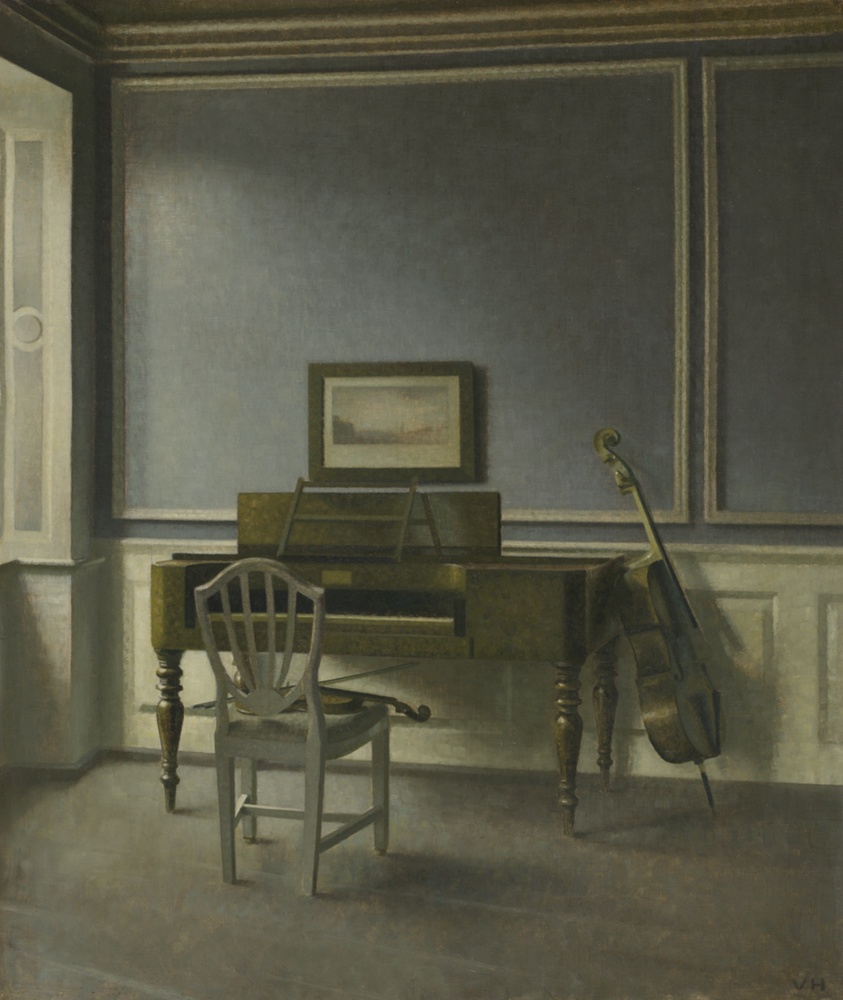
Interior. The Music Room, Strandgade 30
Vilhelm Hammershøi (Danish, 1864–1916)LinkedCulture matchlcp-3fa460a1f213
- Date
- 1907
- Medium
- Oil on canvas
- Culture
- Denmark
- Department
- Painting and Sculpture of Europe
- Institution
- Art Institute of Chicago
- Object ID
- 270002
From the Art Institute of Chicago record
On September 15, 1898, Vilhelm Hammershøi and his wife Ida moved to an apartment on the upper floor of Strandgade 30 in Copenhagen, where they remained until 1909. This stay coincided with the most productive period of the artist’s career, during which he painted his best-known series of works: ever-evolving variations on the interior of his apartment. Hammershøi regularly depicted this corner of his drawing room, both with and without the figure of Ida. For the artist, the apartment was akin to a stage set, and he used furniture and household objects like props, endlessly positioning and repositioning them not according to their domestic function but rather to their aesthetic effect. In Interior. The Music Room, Strandgade 30 , a minimal arrangement featuring musical instruments is illuminated by soft light filtering through a window just outside the frame. But without a human presence to animate the instruments, the scene evokes only silence. Carefully painted with small, flickering brushstrokes, the picture embodies the poet Rainer Maria Rilke’s observation that “Hammershøi is not one of those about whom one must speak quickly. His work is long and slow, and at whichever moment one apprehends it, it will offer plentiful reasons to speak of what is important and essential in art.” This is one of thirty-five works that comprise the Winterbotham Collection. Click here to learn more about the collection.
The authoritative record is held by Art Institute of Chicago. LinkedCulture surfaces this object and its connections; it does not alter institutional metadata.
Get printable QR codesHide QR codes
Open QR codes for this object page and the museum record. They stay collapsed until needed.
Provenance & credit
As published by the source institution. Coverage varies — not every institution's open-data feed includes ownership history.
- Credit line
- Joseph Winterbotham Collection
- Provenance
- Winkel & Magnussen, Copenhagen, October 1910, lot 17. Ole Olsen (1863–1943), Copenhagen, by 1916 [Copenhagen 1916]; with his daughter, Lady Elvira Abrahamsen (born Olsen; 1896–1981), Copenhagen, by 1941 [Copenhagen 1941]; sold, Olsen sale, Winkel & Magnussen, Copenhagen, Feb. 28, 1944, lot 717, to a private collection, Copenhagen; by descent through the family; sold, Sotheby's, New York, May 16, 2023 to the Art Institute of Chicago.
Linked open data
Authority identifiers that link this record into the wider web of cultural data — stable references you can follow to the source.
- Object type
- AAT300033618
Related across collections
Semantically similar works from Art Institute of Chicago and other institutions.