Art Institute of Chicago
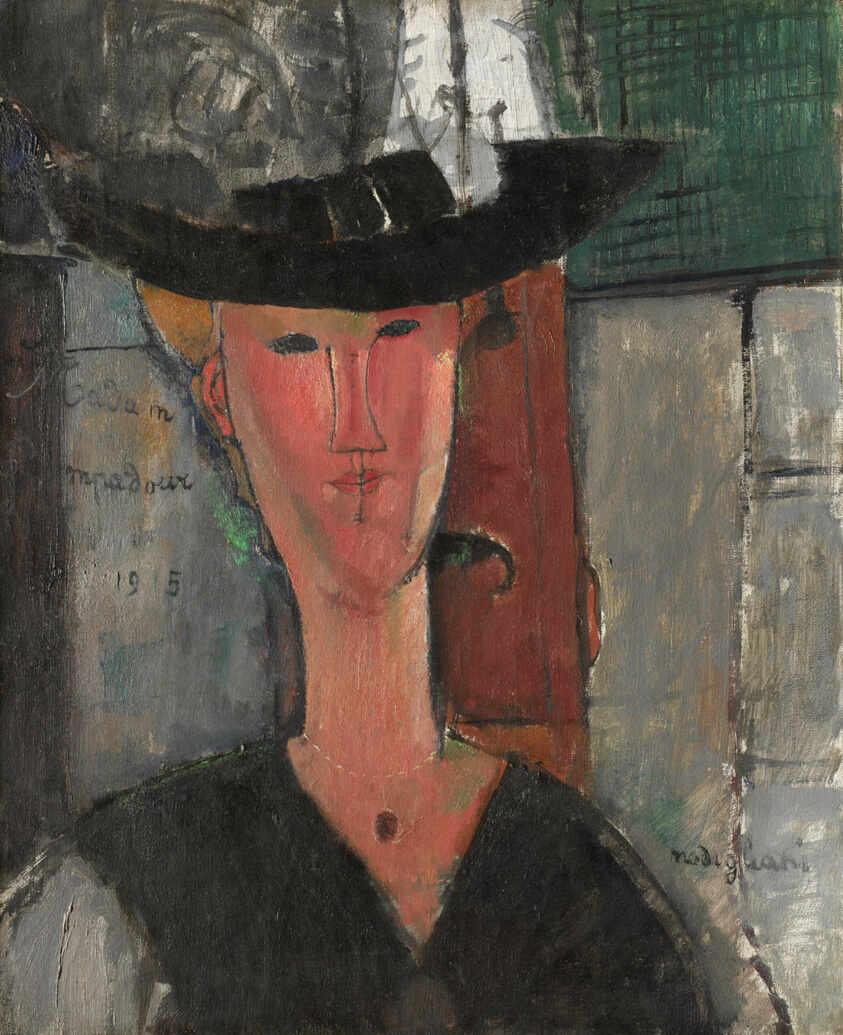
Madam Pompadour
Amedeo ModiglianiLinkedCulture matchlcp-bfc75ba621ed
- Date
- 1915
- Medium
- Oil on canvas
- Culture
- Italy
- Department
- Modern Art
- Institution
- Art Institute of Chicago
- Object ID
- 27281
From the Art Institute of Chicago record
Born of Jewish parents in the Italian coastal town of Leghorn, Amedeo Modigliani settled in Paris in 1906, where he developed friendships with Pablo Picasso , the poet Max Jacob, the sculptor Constantin Brancusi , and other members of the literary and artistic avant-garde, many of whom appear in his portraits. He led a notoriously bohemian life, shortened by a self-destructive use of alcohol and drugs. Modigliani produced his finest paintings between 1914 and his premature death in 1920. Within a limited range of subjects, mainly portraits and nudes, he developed a highly distinctive style of sensitively elongated forms. In this portrait, Modigliani's emphasis is on a strong formal structure dominated by the grid in the background and the echoing curves of the sitter's hat, shoulders, and features. There is none of the pathos often associated with his work. The artist seems instead to have invested this portrait with a note of ironic detachment, even humor, reflected in both the title of the painting (which refers to Madame de Pompadour, mistress of King Louis XV of France) and the expression of amused inscrutability worn by the sitter. Were painter and sitter perhaps both amused by the flamboyant hat? Modigliani's skill in rhyming forms, while at the same time keeping us visually interested and slightly off-balance, is evident throughout the picture, which resonates with the lessons of Paul Cezanne , Cubism, and African sculpture. The sitter for this portrait may well have been Beatrice Hastings, an English poetess who was Modigliani's mistress at the time. Because of the artist's tendency to generalize his sitter's features, however, a comparison of this portrait with others of Hastings is inconclusive. —Entry, Margherita Andreotti, Art Institute of Chicago Museum Studies , Vol. 20, No. 2, The Joseph Winterbotham Collection at The Art Institute of Chicago (1994), p. 150-151. This is one of thirty-five works that comprise the Winterbotham Collection. Click here to learn more about the collection.
The authoritative record is held by Art Institute of Chicago. LinkedCulture surfaces this object and its connections; it does not alter institutional metadata.
Get printable QR codesHide QR codes
Open QR codes for this object page and the museum record. They stay collapsed until needed.
Provenance & credit
As published by the source institution. Coverage varies — not every institution's open-data feed includes ownership history.
- Credit line
- Joseph Winterbotham Collection
- Provenance
- Paul Guillaume (1891–1934), Paris, acquired directly from the artist, by 1916 [Paris 1916]. Léopold Zborowski, Paris (1889–1932), by Dec. 1920 [Paris 1920; Mar. 3, 2026 email correspondence from Julia May Boddewyn, copies in curatorial object file]. Marthe Lederlin (née Hatt, 1882–1980), Paris, by Mar. 23, 1933; sold, Galerie Charpentier, Collection Madame Lederlin, Mar. 23, 1933, lot. 134, to Aram D. Mouradian (1892–1974), Paris (Galerie Van Leer, later Galerie Mouradian-Vallotton). Paul Guillaume, Paris, by 1934; by descent to Domenica Guillaume (later Domenica Walter, 1898–1977), 1934; consigned to Valentine Gallery, New York, by Dec. 29, 1937 [letter from Daniel Catton Rich to Joseph Winterbotham dated Dec. 29, 1937, copy in curatorial object file]; sold to the Art Institute of Chicago, Mar. 24, 1938.
Linked open data
Authority identifiers that link this record into the wider web of cultural data — stable references you can follow to the source.
- Object type
- AAT300033618
Related across collections
Semantically similar works from Art Institute of Chicago and other institutions.