Art Institute of Chicago
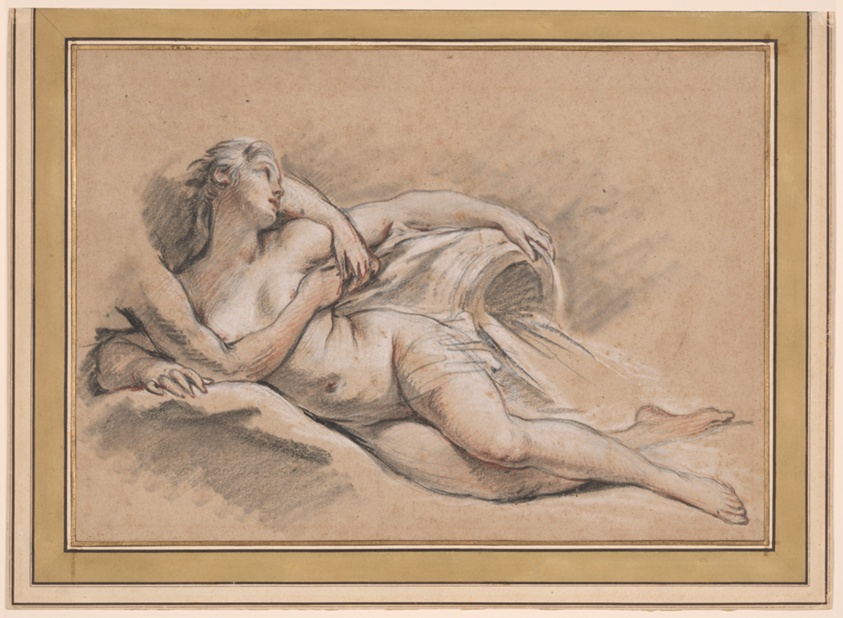
Study after Apollo Revealing his Divinity before the Shepherdess Isse
Studio of François BoucherLinkedCulture matchlcp-6c3a0ffe5ce9
- Date
- c. 1750
- Medium
- Black chalk, with stumping and red chalk, heightened with white chalk, on buff laid paper, laid down on cream laid card
- Culture
- France
- Department
- Prints and Drawings
- Institution
- Art Institute of Chicago
- Object ID
- 27318
From the Art Institute of Chicago record
“I have seen enough of bosoms and buttocks,” wrote the French philosopher and critic Denis Diderot (1713–1784), discussing the paintings of François Boucher. What Diderot and others considered Boucher’s decadent frivolity was associated with the excesses and corruption of the monarchy (Boucher was named first painter to the king in 1765). In other words, Boucher’s work was seen as embodying, in aesthetic form, everything that led to the French Revolution. His style was rejected by the next generation of artists in France in favor of a simpler, more honest style inspired by ancient Rome and Greece.
The authoritative record is held by Art Institute of Chicago. LinkedCulture surfaces this object and its connections; it does not alter institutional metadata.
Get printable QR codesHide QR codes
Open QR codes for this object page and the museum record. They stay collapsed until needed.
Provenance & credit
As published by the source institution. Coverage varies — not every institution's open-data feed includes ownership history.
- Credit line
- Helen Regenstein Collection
- Provenance
- David-Weill (died 1952), Paris, from 1913-at least 1938 [according to Henriot 1925 and Société de Reproduction de Dessins de Maítres 1913; New York 1938]. Georges Wildenstein (died 1963), by 1954 [according to Lossky 1954]. John Goelet (?) [according to invoice in curatorial file]. Barbara Hutton (died 1977) [according to invoice]. Sold, Sotheby's, London, July 8, 1964, "Important Master Drawings," lot 89, to Mrs. Slatkin; sold by Charles E. Slatkin Gallery, New York, to the Art Institute, 1967.
Linked open data
Authority identifiers that link this record into the wider web of cultural data — stable references you can follow to the source.
- Object type
- AAT300033973
Related across collections
Semantically similar works from Art Institute of Chicago and other institutions.