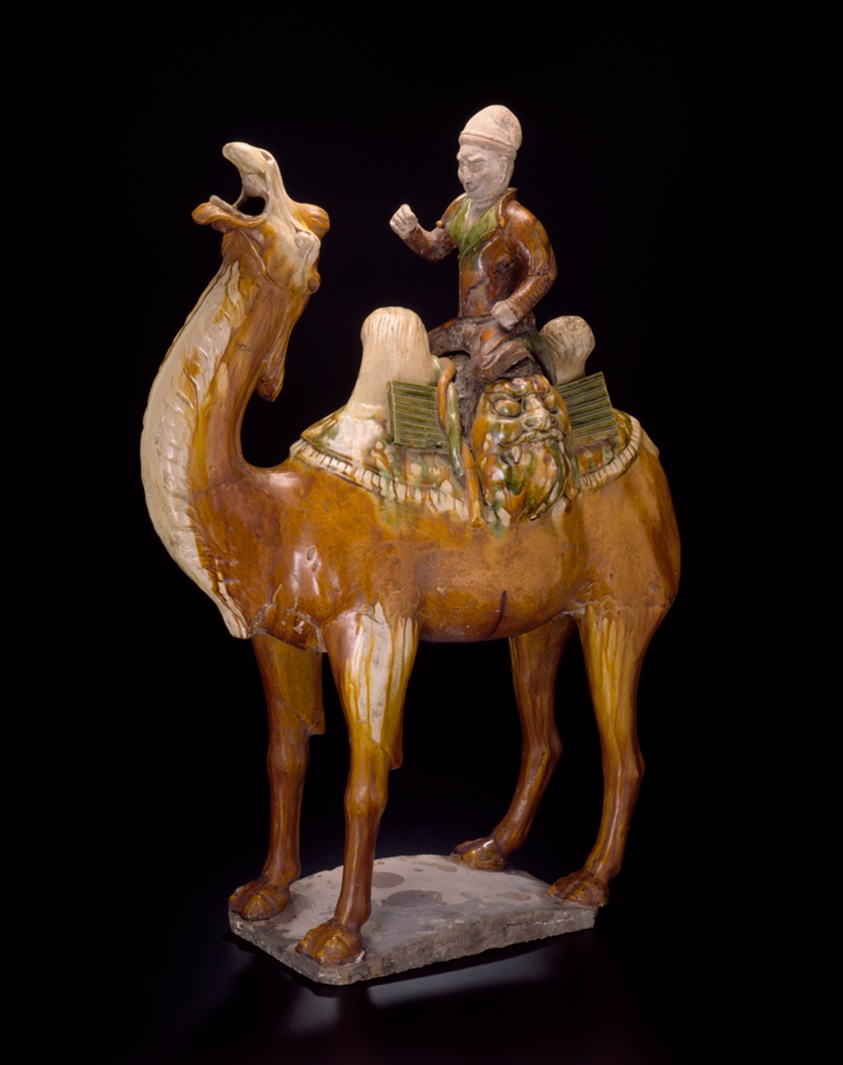
Camel and Rider

Art Institute of Chicago

Camel and Rider

China

Date
Tang dynasty (618–907), first half of 8th century
Medium
Earthenware with three-color (sancai) lead glazes
Culture
China
Department
Arts of Asia
Institution
Art Institute of Chicago

Sculptors of tomb figures keenly observed and then skillfully rendered in clay the caravans of Bactrian camels. These animals were led by grooms who hailed from the Taklamakan Desert located in China’s northwestern border regions. In Tang-dynasty China, camels were novelties, considered auspicious because their packs carried valuable goods from the West.

The authoritative record is held by Art Institute of Chicago. LinkedCulture surfaces this object and its connections; it does not alter institutional metadata.

Linked open data

Authority identifiers that link this record into the wider web of cultural data — stable references you can follow to the source.

Object type
AAT300301253

Related across collections

Semantically similar works from Art Institute of Chicago and other institutions.

Two camels and a groom (Camel)

Two camels and a groom (Camel)

Minneapolis Institute of Art

Tomb figure of a kneeling camel with driver

Tomb figure of a kneeling camel with driver

Minneapolis Institute of Art

Buff-Colored Camel, from the tomb sculpture set: Two Standing, Braying Camels, One Buff, One White, Their Backs Laden with Goods

Buff-Colored Camel, from the tomb sculpture set: Two Standing, Braying Camels, One Buff, One White, Their Backs Laden with Goods

Harvard Art Museums

White-Colored Camel, from the tomb sculpture set: Two Standing, Braying Camels, One Buff, One White, Their Backs Laden with Goods

White-Colored Camel, from the tomb sculpture set: Two Standing, Braying Camels, One Buff, One White, Their Backs Laden with Goods

Harvard Art Museums

Camel with Rider (Tomb Figure)

Camel with Rider (Tomb Figure)

Cleveland Museum of Art

Equestrian Male, from the tomb sculpture set: Two Equestrian Figures, One Male with a Tall, Elaborately Embellished Hat, One Female with Hair in a Topknot, Both with Pointed Boots, and Hands Positioned to Hold the Reins of their Standing, Saddled Horses

Equestrian Male, from the tomb sculpture set: Two Equestrian Figures, One Male with a Tall, Elaborately Embellished Hat, One Female with Hair in a Topknot, Both with Pointed Boots, and Hands Positioned to Hold the Reins of their Standing, Saddled Horses

Harvard Art Museums

Equestrian Female, from the tomb sculpture set: Two Equestrian Figures, One Male with a Tall, Elaborately Embellished Hat, One Female with Hair in a Topknot, Both with Pointed Boots, and Hands Positioned to Hold the Reins of their Standing, Saddled Horses

Equestrian Female, from the tomb sculpture set: Two Equestrian Figures, One Male with a Tall, Elaborately Embellished Hat, One Female with Hair in a Topknot, Both with Pointed Boots, and Hands Positioned to Hold the Reins of their Standing, Saddled Horses

Harvard Art Museums

Tomb Figurine in the Form of a Standing, Plump Court Lady with Upturned, Pointed Shoes and an Elaborate Coiffure, Her Hands in a Gesture at Chest Level

Tomb Figurine in the Form of a Standing, Plump Court Lady with Upturned, Pointed Shoes and an Elaborate Coiffure, Her Hands in a Gesture at Chest Level

Harvard Art Museums

Seated Leonine Chimera, Probably a Guardian Creature, with Wings and Spiked Spine

Seated Leonine Chimera, Probably a Guardian Creature, with Wings and Spiked Spine

Harvard Art Museums

One of Two Standing, Mustachioed Male Figures, Each Wearing a Cape and a Full, Rounded Hat with Protective Neck and Ear Flap, and Each with His Hands Clasped at the Waist and Concealed under His Cape

One of Two Standing, Mustachioed Male Figures, Each Wearing a Cape and a Full, Rounded Hat with Protective Neck and Ear Flap, and Each with His Hands Clasped at the Waist and Concealed under His Cape

Harvard Art Museums

Tomb tile

Tomb tile

Minneapolis Institute of Art

Groomsman, from a three-piece group

Groomsman, from a three-piece group

Minneapolis Institute of Art