Art Institute of Chicago
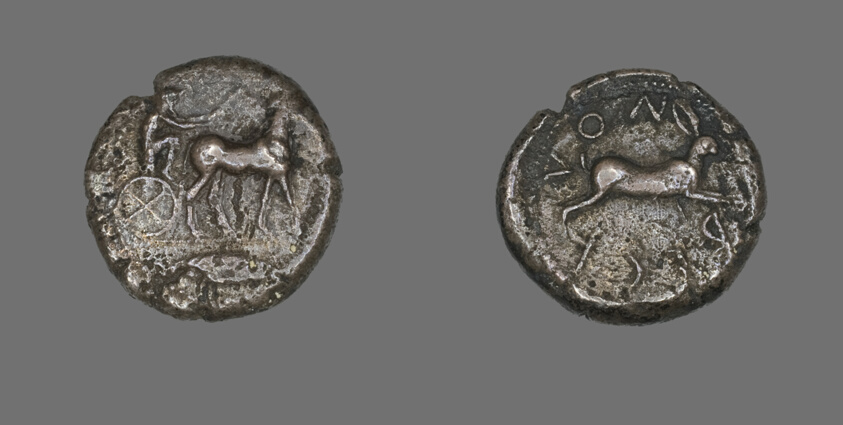
Tetradrachm (Coin) Depicting a Charioteer
Greek; Rhegium, ItalyLinkedCulture matchlcp-37fb2151e739
- Date
- 5th century BCE
- Medium
- Silver
- Culture
- Reggio di Calabria
- Department
- Arts of Greece, Rome, and Byzantium
- Institution
- Art Institute of Chicago
- Object ID
- 36616
From the Art Institute of Chicago record
The front (obverse) of this coin depicts a seated charioteer, bearded, riding behind two mules walking right; in the field below is an olive leaf. The back (reverse) of the coin depicts a hare leaping to the right. When Anaxilas, son of Cretines, seized power at Rhegium (modern Reggio Calabria in southern Italy) in 494 BCE, along with parts of Sicily soon after, he adopted the image of a leaping hare on his coinage as early as 480 BCE. Aristotle (quoted by Pollux, Onomasticon 5.75) reported that Anaxilas introduced hares to Sicily for the sport of hunting and also that he was victorious in the Olympic games. The image of his mule-chariot (biga) on the front of the coin commemorates this victory. The olive leaf in the field below the chariot symbolizes the olive crown awarded to victors at the Olympic Games. The hare may also symbolize the speed of Anaxilas' chariot.
The authoritative record is held by Art Institute of Chicago. LinkedCulture surfaces this object and its connections; it does not alter institutional metadata.
Get printable QR codesHide QR codes
Open QR codes for this object page and the museum record. They stay collapsed until needed.
Provenance & credit
As published by the source institution. Coverage varies — not every institution's open-data feed includes ownership history.
- Credit line
- Gift of Emily Crane Chadbourne
- Provenance
- Emily Crane Chadbourne (1871- 1964), Paris, London, and Chicago; given to the Art Institute of Chicago, 1940.
Linked open data
Authority identifiers that link this record into the wider web of cultural data — stable references you can follow to the source.
- Object type
- AAT300037334
Part of a LinkedCulture topic
 Ancient Greek Silver Tetradrachms
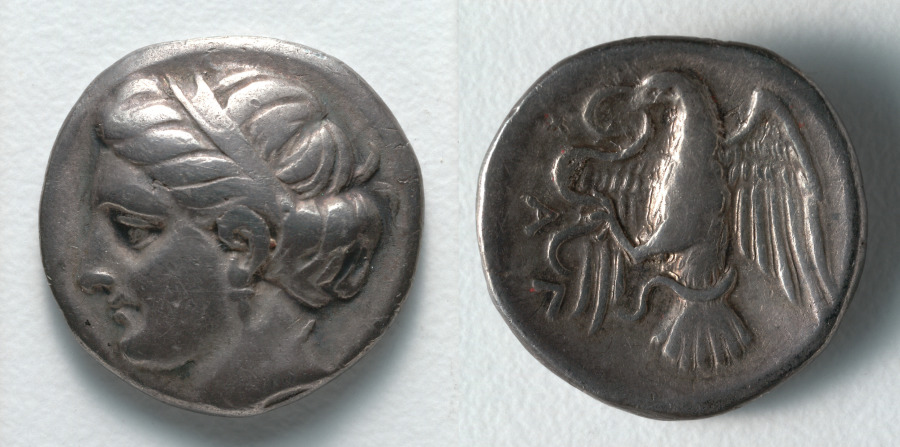
These objects are all tetradrachm coins, a standard ancient Greek silver denomination, depicting various deities and symbols from Greek city-states and territories across the Mediterranean.
333 objects from 3 institutions
Related across collections
Semantically similar works from Art Institute of Chicago and other institutions.