Art Institute of Chicago
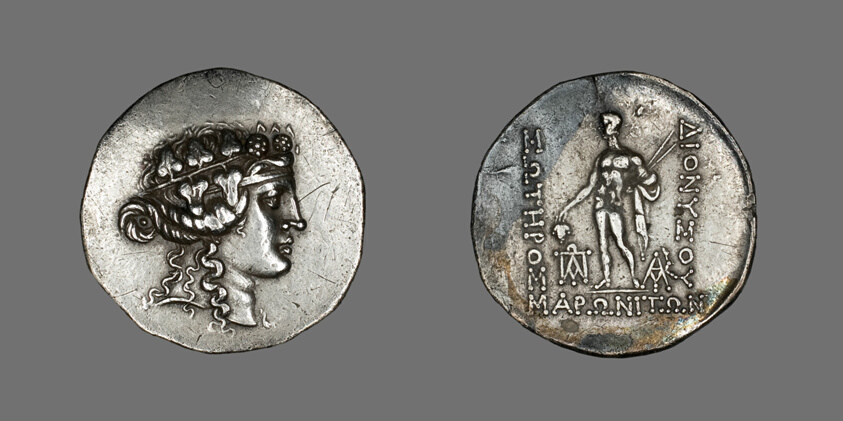
Tetradrachm (Coin) Depicting the God Dionysos
Greek; minted in Maroneia, ThraceLinkedCulture matchlcp-414ef4cb16fc
- Date
- mid–2nd century BCE
- Medium
- Silver
- Culture
- Greece
- Department
- Arts of Greece, Rome, and Byzantium
- Institution
- Art Institute of Chicago
- Object ID
- 36623
From the Art Institute of Chicago record
The front (obverse) of this coin depicts the god Dionysos crowned with ivy leaves, one of the attributes (along with the grapes he holds on the coin's back) which identifies him as the god of wine. He is believed to have come from Thrace, where this coin was minted. Many cities claimed to be the birthplace of Dionysos. One was Maroneia, on the coast of Thrace, which was said to be named after Dionysos’s son Maron. Dionysos was the city’s protective deity and appeared on its coinage crowned with ivy leaves. On the back (reverse) of the coin, the god is seen holding a bunch of grapes.
The authoritative record is held by Art Institute of Chicago. LinkedCulture surfaces this object and its connections; it does not alter institutional metadata.
Get printable QR codesHide QR codes
Open QR codes for this object page and the museum record. They stay collapsed until needed.
Provenance & credit
As published by the source institution. Coverage varies — not every institution's open-data feed includes ownership history.
- Credit line
- Gift of Emily Crane Chadbourne
- Provenance
- Emily Crane Chadbourne (1871- 1964), Paris, London, and Chicago; given to the Art Institute of Chicago, 1940.
Linked open data
Authority identifiers that link this record into the wider web of cultural data — stable references you can follow to the source.
- Object type
- AAT300037334
Part of a LinkedCulture topic
 Ancient Greek Silver Tetradrachms
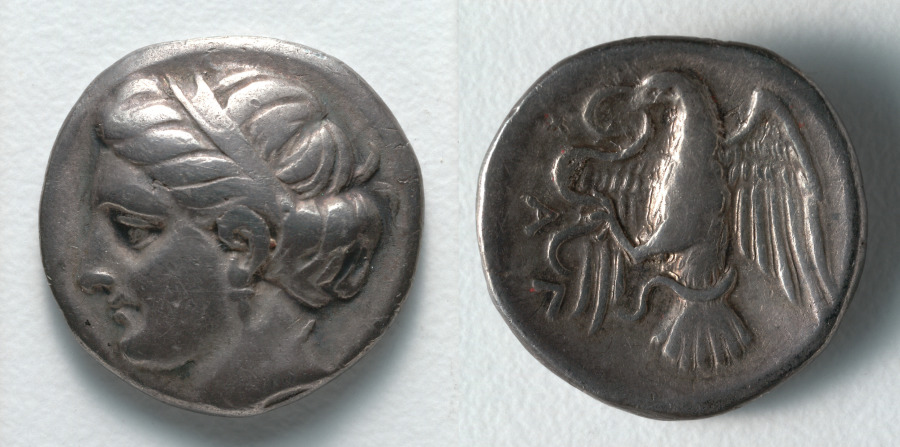
These objects are all tetradrachm coins, a standard ancient Greek silver denomination, depicting various deities and symbols from Greek city-states and territories across the Mediterranean.
333 objects from 3 institutions
Related across collections
Semantically similar works from Art Institute of Chicago and other institutions.