Art Institute of Chicago
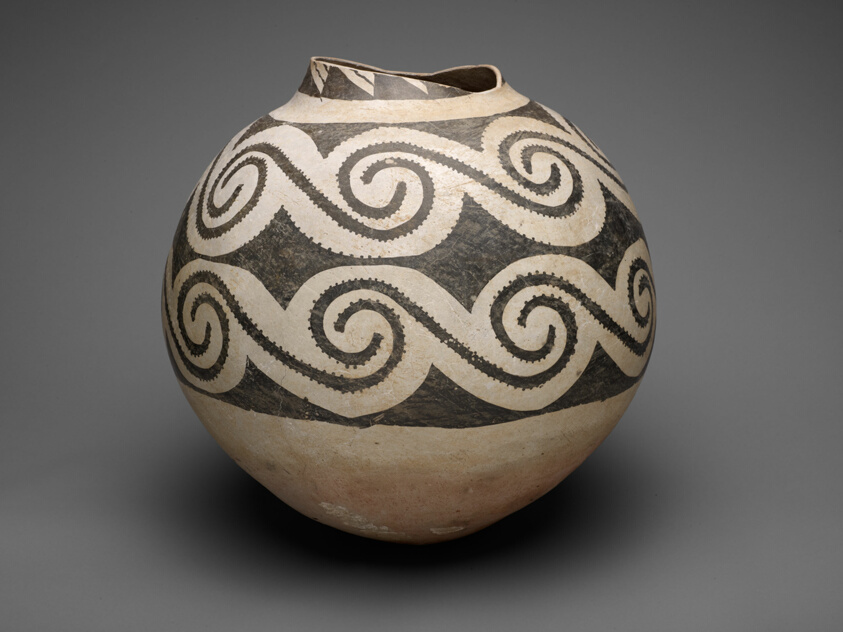
Storage Jar with Horizontal Bands of Interlocking Scrolls
Ceramist unknown (Ancestral Puebloan), Black Mesa Black-on-whiteLinkedCulture matchlcp-650a6b2d3d26
- Date
- 875–1130
- Medium
- Earthenware and pigment
- Culture
- Southwest
- Department
- Arts of the Americas
- Institution
- Art Institute of Chicago
- Object ID
- 51185
From the Art Institute of Chicago record
Ancestors of the modern Pueblo Indians, the Anasazi people flourished in the southwestern United States beginning about two thousand years ago. Ruins of their spectacular cliff dwellings and multistory towns of sandstone masonry are widely scattered in northern New Mexico, Arizona, and southern parts of Utah and Colorado. Skilled farmers, the Ancestral Pueblo (Anasazi) were also creative artisans, as seen in this large, striking olla, a storage vessel. Dramatically decorated in the black-on-white ground of the Black Mesa style, the vessel displays a continuous swirling band of barbed, interlocking S shapes. This strong rhythmic pattern is best perceived from above, suggesting that the olla’s usual placement was on the floor. Like most ollas, this vessel originally had a taller neck, which broke off and was ground down by its owner. In Ancestral Pueblo (Anasazi) tradition, as among the Pueblos today, ceramic vessels were primarily made by women. The potter’s wheel was unknown, and skilled artisans created the evenly thin walls of their vessels by the coiling method. In this technique, the pot is built up with successive coils of clay that are then patted and thinned to achieve the final globular shape. Designs are painted using liquefied clay slips with mineral colors before firing the vessel in an open environment instead of a kiln.
The authoritative record is held by Art Institute of Chicago. LinkedCulture surfaces this object and its connections; it does not alter institutional metadata.
Get printable QR codesHide QR codes
Open QR codes for this object page and the museum record. They stay collapsed until needed.
Provenance & credit
As published by the source institution. Coverage varies — not every institution's open-data feed includes ownership history.
- Credit line
- Tillie C. Cohn Fund
- Provenance
- Charles F. Cleland, Pueblo One Indian Arts, Scottsdale, AZ, by Aug. 1976 [letter from C. Cleland, Aug. 30. 1976; invoice, Pueblo One Indian Arts, Sept. 9, 1976; copies in curatorial object file]; sold to the Art Institute of Chicago, 1976.
Linked open data
Authority identifiers that link this record into the wider web of cultural data — stable references you can follow to the source.
- Object type
- AAT300386308
Related across collections
Semantically similar works from Art Institute of Chicago and other institutions.