Art Institute of Chicago
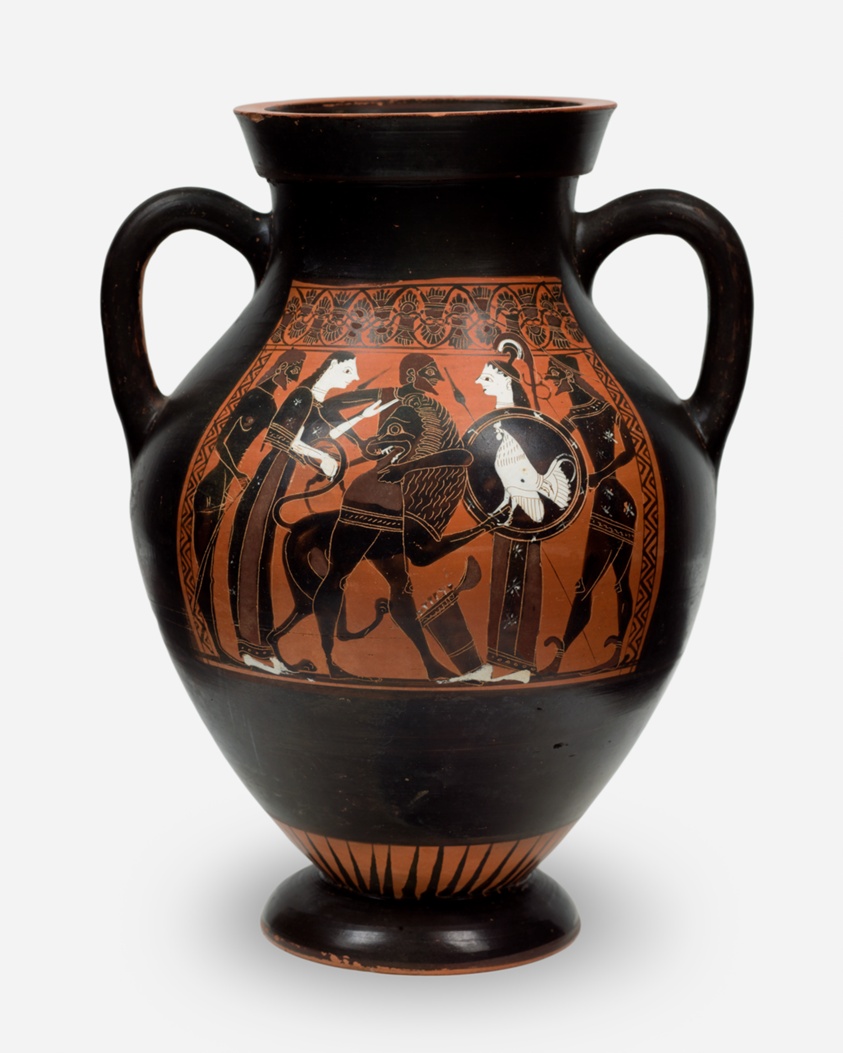
Belly-Amphora (Storage Jar)
Attributed to the Painter of Berlin 1686 or the Painter of Tarquinia RC 3984LinkedCulture matchlcp-946fb63198e5
- Date
- 550-540 BCE
- Medium
- terracotta, black-figure
- Culture
- Athens
- Department
- Arts of Greece, Rome, and Byzantium
- Institution
- Art Institute of Chicago
- Object ID
- 52198
From the Art Institute of Chicago record
Ancient artists frequently depicted events from the life of the demigod Herakles, especially the Twelve Labors he had to complete to attain immortality. On this amphora (storage jar) the great hero completes his first assignment—to kill a lion with an invincible hide that was terrorizing the village of Nemea. Here the contest has been decided; Herakles strangles the lion, whose jaws he has pried open with his bare hands. To the right stand Athena and Hermes; on the other stand a nymph and Iolaos, Herakles’s nephew and companion. In subsequent episodes, Herakles often wears the lion’s pelt, either as a headdress or over his arm, as a protective cloak. These vases were used for the transport and storage of items such as wine and olives, and they were given as prizes in athletic competitions. Many vases have been damaged, either in antiquity or in modern times, and repaired. However, this amphora remains intact, with only a few losses, such as the chips on the rim, and some surface abrasion. The vivid white gloss that highlights the women’s skin and the shield is especially well preserved.
The authoritative record is held by Art Institute of Chicago. LinkedCulture surfaces this object and its connections; it does not alter institutional metadata.
Get printable QR codesHide QR codes
Open QR codes for this object page and the museum record. They stay collapsed until needed.
Provenance & credit
As published by the source institution. Coverage varies — not every institution's open-data feed includes ownership history.
- Credit line
- Katherine K. Adler Memorial Fund
- Provenance
- Summa Galleries, Beverly Hills, by 1977 [according to a letter from Dietrich von Bothmer dated June 9, 1978, in curatorial object file]; Earl Keefer, Culver City, by 1978; sold to the Art Institute of Chicago, 1978.
Linked open data
Authority identifiers that link this record into the wider web of cultural data — stable references you can follow to the source.
- Object type
- AAT300193015
Related across collections
Semantically similar works from Art Institute of Chicago and other institutions.