Art Institute of Chicago
The Fountains
Hubert Robert (French, 1733-1808)LinkedCulture matchlcp-3fa2142118d3
- Date
- 1787–88
- Medium
- Oil on canvas
- Culture
- France
- Department
- Painting and Sculpture of Europe
- Institution
- Art Institute of Chicago
- Object ID
- 57051
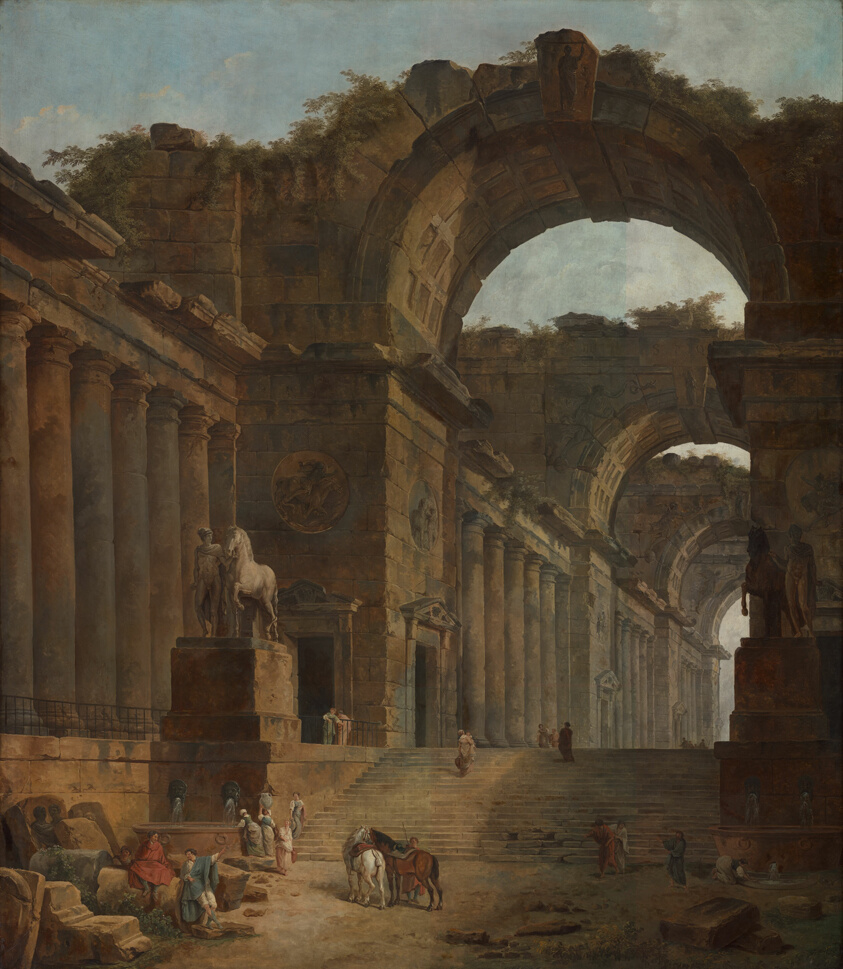
The painting of Classical ruins had reached the zenith of its popularity when Hubert Robert, the leading French practitioner of this specialty, was commissioned in 1787 to paint a suite of four canvases for a wealthy financier’s château at Méréville, near Paris. The Fountains and its companion pieces were set into the paneled walls of a salon in the château, creating an alternate space that played off of the elegant, Neoclassical decor of the room. Robert has studied in Rome from 1754 to 1765 and there had gleaned his artistic vocabulary. Like the other three large paintings from the group painted for Méréville, all in the Art Institute, The Fountains exploits Robert’s typical vocabulary of fictive niches, arches, coffered vaults, colonnades, majestic stairwells, and Roman statuary to create a fantasy of expansive space. The four paintings are inhabited by tiny figures in the foreground; these serve only to set the scale and animate the scene, for the ruins themselves are the true subject of the pictures. In his use of ruins, Robert embodied the notion of the relationship of mankind and the built environment to nature that was expressed by the French philosopher and encyclopedist Denis Diderot: “Everything vanishes, everything dies, only time endures.”
The authoritative record is held by Art Institute of Chicago. LinkedCulture surfaces this object and its connections; it does not alter institutional metadata.
Get printable QR codesHide QR codes
Open QR codes for this object page and the museum record. They stay collapsed until needed.
Provenance & credit
As published by the source institution. Coverage varies — not every institution's open-data feed includes ownership history.
- Credit line
- Gift of William G. Hibbard
- Provenance
- Commissioned with its pendants (1900.382, 1900.383, 1900.384) by Jean Joseph, marquis de Laborde (died 1794), in 1787 for the Château de Méréville (near Etampes); the château was sold by Mme de Laborde, 1819 [see Simone de Lassus, “Quelques Détails inédits sur Méréville,” Bulletin de la Société de l’histoire de l’art français, année 1976 (1978), p. 286 n. 1]; the château was owned successively by: M. Ters and Mme d’Espagnat (sold 1824); comte de Saint-Roman (sold 1866); duc de Sessa (sold 1868); M. and Mme Beleys (sold 1869); la Société Cail (sold 1874); M. Heddle (sold 1889); Adam Natanson (sold 1890); M. Hériot (sold 1896); Prudent Carpentier (sold 1897, at which time the contents of the house were dispersed and the paintings probably sold) [See Simone de Lassus 1978, cited above; a letter from Bernard Binvel to Susan Wise dated May 5, 1987 states, perhaps erroneously, that Hériot sold the paintings in July of 1896]. M. L. François; sold Galerie George Petit, Paris, June 13, 1900, no. 3, to Durand-Ruel, acting on behalf of the Art Institute, with funds provided by William G. Hibbard, 1900.
Linked open data
Authority identifiers that link this record into the wider web of cultural data — stable references you can follow to the source.
- Object type
- AAT300033618
Related across collections
Semantically similar works from Art Institute of Chicago and other institutions.