Art Institute of Chicago
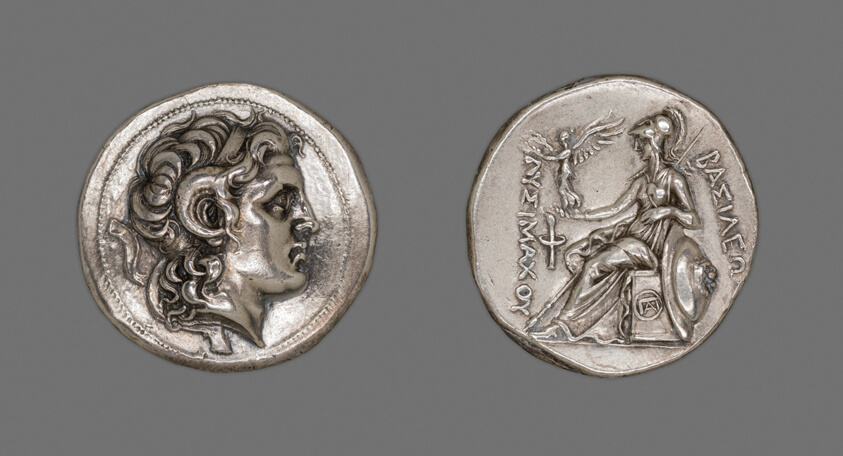
Tetradrachm (Coin) Portraying Alexander the Great
Greek; minted in Ephesus, Asia Minor (modern Turkey)LinkedCulture matchlcp-9aa45c5d6fcb
- Date
- 297-281 BCE, issued by King Lysimachus of Thrace
- Medium
- Silver
- Culture
- Ephesus
- Department
- Arts of Greece, Rome, and Byzantium
- Institution
- Art Institute of Chicago
- Object ID
- 5764
From the Art Institute of Chicago record
Following the premature death of Alexander the Great in 323 BCE, his generals, friends, and heirs engaged in forty years of wars over his empire. Lysimachus (reigned 323–281 BCE), one of Alexander’s companions and bodyguards, used the king’s image on his own coins in order to cast himself in the role of successor and legitimize his claim to the kingdom of Thrace. Alexander, responsible for establishing the conventions of royal portraiture, is depicted in his preferred manner: youthful and clean-shaven, with long locks of hair rising above his forehead and eyes cast upward. Additionally, he is shown with horns curling around his ears. These “horns of Ammon” symbolize Alexander’s claim that he was the son of the Egyptian god Ammon—a claim reportedly confirmed by the oracle at the sanctuary of Zeus-Ammon at Siwa, Egypt. On the reverse of the coin, Lysimachus exerts his own royal autonomy by naming himself “king.” The goddesses Athena and Nike (Greek for “victory”) crown his name with laurels, which symbolized victory or honor. The lion on the shield at Athena’s side references Lysimachus’s famous exploit of killing a lion with his bare hands and reinforces his association with Alexander, who used the skin of the Nemean lion as a symbol of power and courage.
The authoritative record is held by Art Institute of Chicago. LinkedCulture surfaces this object and its connections; it does not alter institutional metadata.
Get printable QR codesHide QR codes
Open QR codes for this object page and the museum record. They stay collapsed until needed.
Provenance & credit
As published by the source institution. Coverage varies — not every institution's open-data feed includes ownership history.
- Credit line
- Gift of Martin A. Ryerson
- Provenance
- Martin A. Ryerson (1856-1932), Chicago; given to the Art Institute of Chicago, 1922.
Linked open data
Authority identifiers that link this record into the wider web of cultural data — stable references you can follow to the source.
- Object type
- AAT300037334
Related across collections
Semantically similar works from Art Institute of Chicago and other institutions.