Art Institute of Chicago
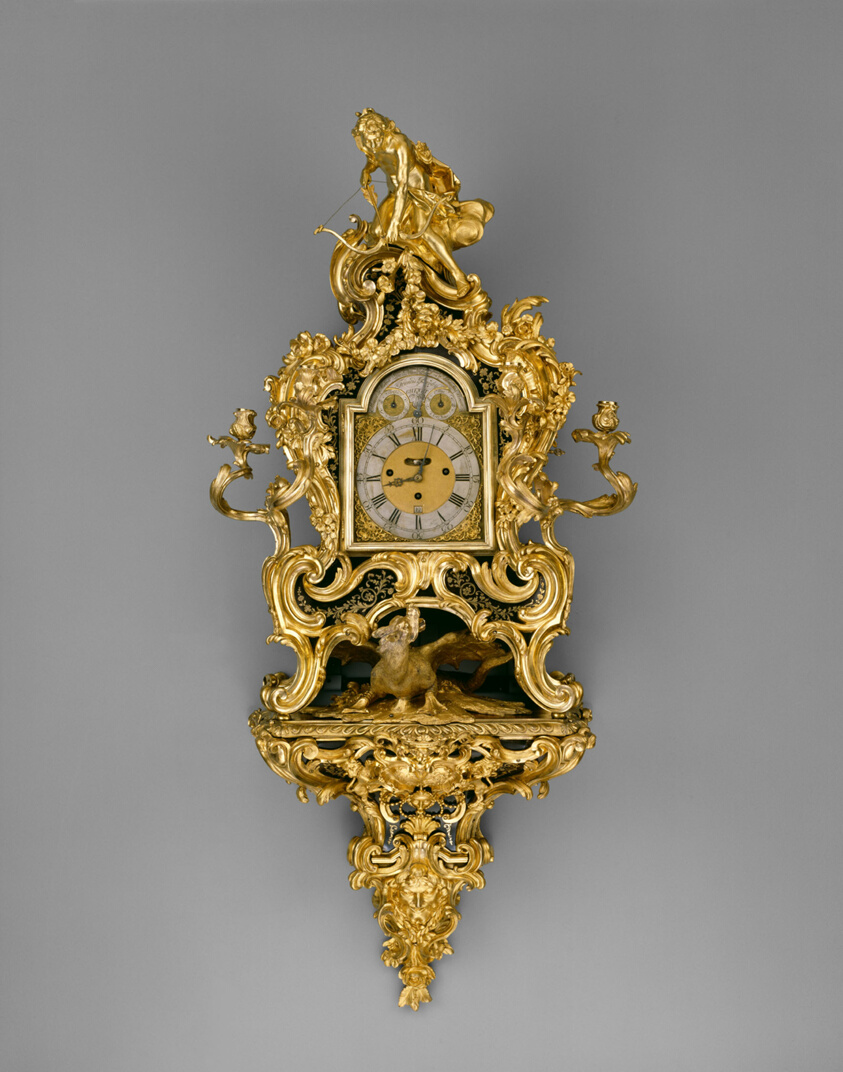
Wall Clock
Case by Jean-Pierre Latz (born Cologne [now Germany], active France, 1691–1754)LinkedCulture matchlcp-08af23553dbd
- Date
- c. 1735–40
- Medium
- Oak, tortoiseshell, kingwood, brass, gilded bronze, and glass
- Culture
- France
- Department
- Applied Arts of Europe
- Institution
- Art Institute of Chicago
- Object ID
- 57819
From the Art Institute of Chicago record
An exuberant and lavish example of the French Rococo style, this sculptural wall clock epitomizes the extravagant era of Louis XV (reigned 1715–74). Festooned with ormolu (gilt bronze) swirls and floral swags, the clock required the collaboration of numerous specialized artisans. Its case, candelabra, and wall bracket were created by the eminent Jean-Pierre Latz, who was appointed ébéniste (furniture maker) to the king in 1741. The clock’s eight-day movement was manufactured in the Flemish city of Ghent by Francis Bayley, possibly a member of the large London dynasty of clockmakers of that name. Opulent clocks such as this did more than tell time; they delighted the ear with music (six melody titles are engraved in the dial’s arch) and dazzled the eye with dramatic scenes. Here the Greek god Apollo is poised at the top of the clock case to slay the serpent Python. The space between the clock and the wall bracket was cleverly used to suggest the beast’s home, the cave of Mount Parnassus in Greece. In the triangular base are the faces of Zeus, symbolizing time, and Hera, presiding over marriage and childbirth. They are surmounted by two small coats of arms belonging to the Flemish bride and groom whose union the clock was probably created to celebrate.
The authoritative record is held by Art Institute of Chicago. LinkedCulture surfaces this object and its connections; it does not alter institutional metadata.
Get printable QR codesHide QR codes
Open QR codes for this object page and the museum record. They stay collapsed until needed.
Provenance & credit
As published by the source institution. Coverage varies — not every institution's open-data feed includes ownership history.
- Credit line
- Ada Turnbull Hertle Fund
- Provenance
- Ducs d’Arenberg [Hawley 1970]; Rosenberg and Stiebel, Inc., New York, early 1960s [according to letter from Henry Hawley, Nov. 10, 1988; copy in curatorial object file]; Antenor Patiño (1896–1982), Portugal [Hawley 1970]; Rosenberg and Stiebel, Inc., New York; sold to the Art Institute of Chicago, 1975.
Linked open data
Authority identifiers that link this record into the wider web of cultural data — stable references you can follow to the source.
- Object type
- AAT300037336
Part of a LinkedCulture topic
 Decorative Timekeeping Across Cultures
These objects are all ornate clocks from various time periods and regions, showcasing how timekeeping devices served as both functional instruments and decorative art objects across different cultures from the 16th to 19
48 objects from 5 institutions
Related across collections
Semantically similar works from Art Institute of Chicago and other institutions.