Art Institute of Chicago
Panorama from the Sasso
Claude LorrainLinkedCulture matchlcp-4ee380f78974
- Date
- 1649/1655
- Medium
- Pen and brown ink with brush and brown wash, heightened with white gouache and traces of white chalk, over black chalk and graphite, on cream laid paper
- Culture
- France
- Department
- Prints and Drawings
- Institution
- Art Institute of Chicago
- Object ID
- 60031
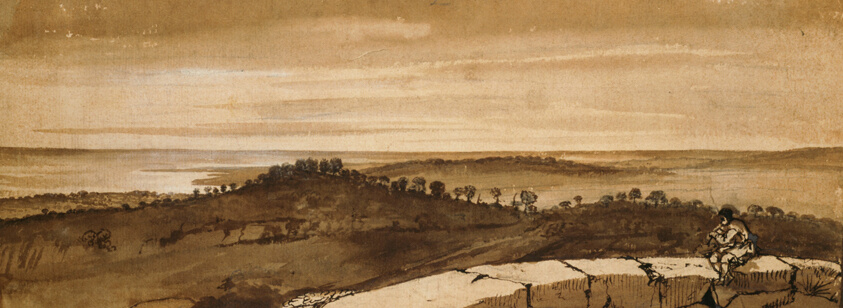
For Claude Lorrain, one of the most important aspects of his adopted city of Rome was its surrounding countryside, the Campagna, which the artist studied, sketched, and painted all his life. His evocative classical landscapes were sought after by papal patrons as well as by aristocrats and royalty throughout Europe. For nearly a century after his death, travelers on the grand tour of European capitals judged real scenery according to his standards. In Claude’s landscapes, as in this superb drawing, order and tranquility prevail; men perform no labor but rather exist peacefully in beautiful pastoral settings blessed by the warm Roman light. Depicted here is the region around the Sasso, a large rock ten miles south of Civitavecchia, Rome’s modern seaport. Evidently made at the site of the rock itself, the drawing is remarkable in its mastery of subtle ink washes that evocatively suggest, rather than describe, the landscape and sea. Individual trees stand out as nearly geometric forms against the unifying light. The drawing’s horizontal format enhances the idyllic landscape’s panoramic sweep, which the viewer savors along with the solitary shepherd.
The authoritative record is held by Art Institute of Chicago. LinkedCulture surfaces this object and its connections; it does not alter institutional metadata.
Get printable QR codesHide QR codes
Open QR codes for this object page and the museum record. They stay collapsed until needed.
Provenance & credit
As published by the source institution. Coverage varies — not every institution's open-data feed includes ownership history.
- Credit line
- Helen Regenstein Collection
- Provenance
- Probably the estate of the artist [Roethlisberger 1973]; probably sold to Queen Christina of Sweden, 1689 [Roethlisberger 1973]. Don Livio Odescalchi, Duke of Bracciano (died 1711), from 1692 [Roethlisberger 1973]; by descent through the Odescalchi family [Folds McCullagh 2000]; sold by Countess Maria Sanminiatelli Odescalchi, Rome, to Richard Feigen, April 15, 1980 [letter from Ann Guite of Richard Feigen of December 1, 2003 in the curatorial file]; sold to the Art Institute, 1980.
Linked open data
Authority identifiers that link this record into the wider web of cultural data — stable references you can follow to the source.
- Object type
- AAT300033973
Related across collections
Semantically similar works from Art Institute of Chicago and other institutions.