Art Institute of Chicago
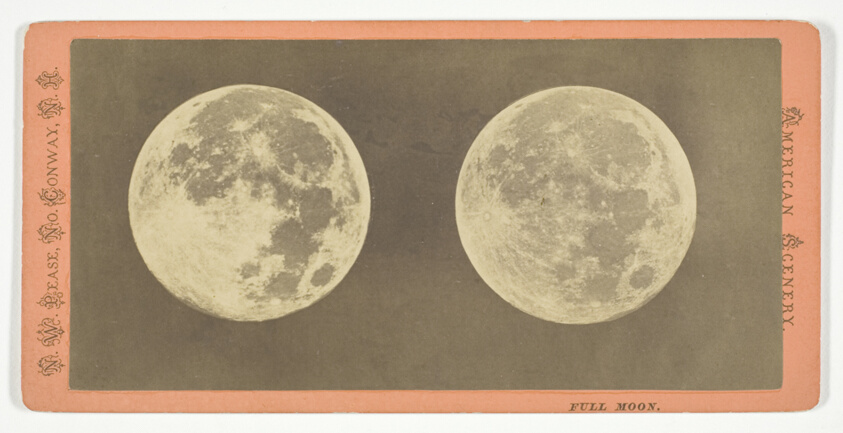
Full Moon
Nathan W. PeaseLinkedCulture matchlcp-83b4c6385d13
- Date
- mid–19th century
- Medium
- Albumen print, stereo
- Culture
- United States
- Department
- Photography and Media
- Institution
- Art Institute of Chicago
- Object ID
- 60126
From the Art Institute of Chicago record
Stereographs were made by taking two photographs of the same scene with lenses about two and a half inches apart to match the distance between human eyes; viewed through a stereoscope, the images combine to give the illusion of depth. Enormously popular from around 1850 to 1930, stereographs documented disasters, expeditions, monuments, and exotic locations by the millions. Nathan Pease, based in New Hampshire, was one of many photographers who ran a brisk trade in stereographic landscapes for tourists and armchair travelers. This stereo image of a full moon was made in an unusual way: because of the distance to the subject, the two standard lenses on a stereographic camera would not be able to render a binocular effect. Instead, the photographer made two images at different times, so that the moon would be in a different orbital location.
The authoritative record is held by Art Institute of Chicago. LinkedCulture surfaces this object and its connections; it does not alter institutional metadata.
Get printable QR codesHide QR codes
Open QR codes for this object page and the museum record. They stay collapsed until needed.
Provenance & credit
As published by the source institution. Coverage varies — not every institution's open-data feed includes ownership history.
- Credit line
- Gift of Robert Jesmer
Linked open data
Authority identifiers that link this record into the wider web of cultural data — stable references you can follow to the source.
- Object type
- AAT300046300
Related across collections
Semantically similar works from Art Institute of Chicago and other institutions.