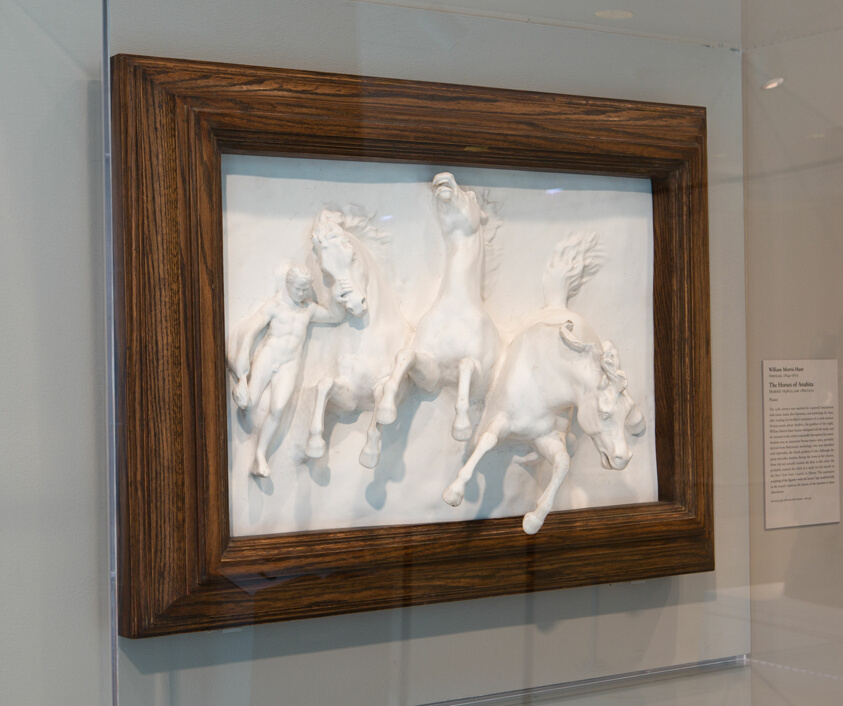
The Horses of Anahita

Art Institute of Chicago

The Horses of Anahita

William Morris Hunt

Date
Modeled 1848–50, cast 1882–1910
Medium
Plaster
Culture
United States
Department
Arts of the Americas
Institution
Art Institute of Chicago

In 1846, after reading his brother’s translation of a sixth-century Persian poem about Anahita, the goddess of the night, William Morris Hunt became intrigued with the myth, and he returned to the subject repeatedly throughout his career. Anahita was an important Persian nature deity, probably derived from Babylonian mythology, who was identified with Aphrodite, the Greek goddess of love. Although the poem describes Anahita fleeing the dawn in her chariot, Hunt did not actually include the deity in this relief. He probably created the relief as a study for his murals in the New York State Capitol, in Albany. The expressive sculpting of the figures—with the horses’ legs modeled fully in the round—captures the drama of the moment in three dimensions.

The authoritative record is held by Art Institute of Chicago. LinkedCulture surfaces this object and its connections; it does not alter institutional metadata.

Linked open data

Authority identifiers that link this record into the wider web of cultural data — stable references you can follow to the source.

Object type
AAT300301253

Related across collections

Semantically similar works from Art Institute of Chicago and other institutions.

Attic Black-Figure Neck-Amphora

Attic Black-Figure Neck-Amphora

Getty Museum

Dish: The Goddess Anahita

Dish: The Goddess Anahita

Cleveland Museum of Art

Gibson, les Heures, bas-relief

Gibson, les Heures, bas-relief

Getty Museum

The Parrot Addresses Khujasta at the Beginning of the Sixth Night, from a Tuti-nama (Tales of a Parrot)

The Parrot Addresses Khujasta at the Beginning of the Sixth Night, from a Tuti-nama (Tales of a Parrot)

Cleveland Museum of Art

The Parrot Addresses Khujasta at the Beginning of the Twenty-Fourth Night, from a Tuti-nama (Tales of a Parrot)

The Parrot Addresses Khujasta at the Beginning of the Twenty-Fourth Night, from a Tuti-nama (Tales of a Parrot)

Cleveland Museum of Art

Ghatotkacha and three demons in his company chase Bhagadatta, from Bhishma-parva (volume six) of a Razm-nama (Book of Wars) adapted from the Sanskrit Mahabharata and translated into Persian by Mir Ghiyath al-Din Ali Qazvini, known as Naqib Khan (Persian, d. 1614)

Ghatotkacha and three demons in his company chase Bhagadatta, from Bhishma-parva (volume six) of a Razm-nama (Book of Wars) adapted from the Sanskrit Mahabharata and translated into Persian by Mir Ghiyath al-Din Ali Qazvini, known as Naqib Khan (Persian, d. 1614)

Cleveland Museum of Art

Shahr-Arai and her lover dallying on a bed beneath which is concealed her husband, from a Tuti-nama (Tales of a Parrot): Fortieth Night

Shahr-Arai and her lover dallying on a bed beneath which is concealed her husband, from a Tuti-nama (Tales of a Parrot): Fortieth Night

Cleveland Museum of Art

The farmer, father of the son with the deceitful wife, steals away with her anklet while she is in bed with her lover, from a Tuti-nama (Tales of a Parrot): Eighth Night

The farmer, father of the son with the deceitful wife, steals away with her anklet while she is in bed with her lover, from a Tuti-nama (Tales of a Parrot): Eighth Night

Cleveland Museum of Art

The mendicant’s wife deceives him with a soldier, from a Tuti-nama (Tales of a Parrot): Fourth Night

The mendicant’s wife deceives him with a soldier, from a Tuti-nama (Tales of a Parrot): Fourth Night

Cleveland Museum of Art

Khurshid reunited with her husband Utarid, from a Tuti-nama (Tales of a Parrot): Thirty-second Night

Khurshid reunited with her husband Utarid, from a Tuti-nama (Tales of a Parrot): Thirty-second Night

Cleveland Museum of Art

The merchant’s daughter encounters a wolf and bandits on her way to meet the gardener in order to keep her promise, from a Tuti-nama (Tales of a Parrot): Twelfth Night

The merchant’s daughter encounters a wolf and bandits on her way to meet the gardener in order to keep her promise, from a Tuti-nama (Tales of a Parrot): Twelfth Night

Cleveland Museum of Art

Judgment of Paris

Judgment of Paris

Cleveland Museum of Art