Art Institute of Chicago
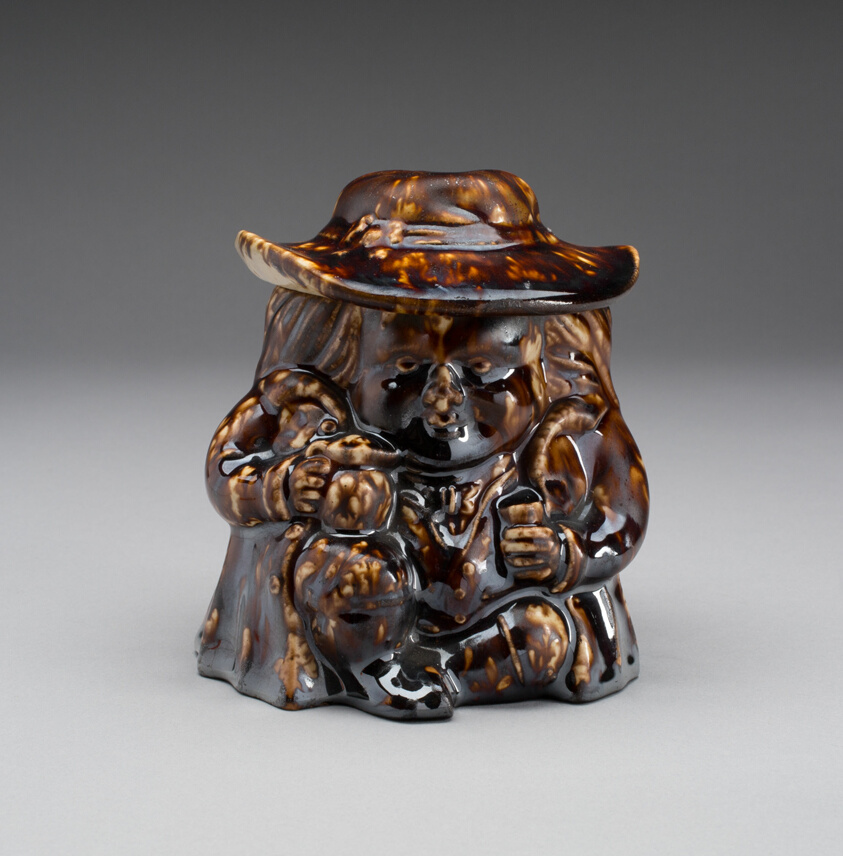
Snuff Jar
Lyman, Fenton & CompanyLinkedCulture matchlcp-cfb16088d976
- Date
- 1849–52
- Medium
- Earthenware
- Culture
- Bennington
- Department
- Arts of the Americas
- Institution
- Art Institute of Chicago
- Object ID
- 67447
From the Art Institute of Chicago record
Beginning in the mid-18th century, English manufacturers introduced yellow-bodied pottery with mottled brown glazing, commonly known as Rockingham ware, to the United States market. By the 1840s, factories in America, aided by English immigrant craftsmen, were producing the pottery to great success. Two of the most notable American makers of Rockingham ware were located in Bennington, Vermont, where potteries had existed since at least 1785, but there were also manufacturers in New Jersey, Ohio, Maryland, and elsewhere. Responding to the utilitarian needs of America’s middle class, these potteries produced a large range of objects, from spittoons to inkwells, snuffboxes to pitchers, and candlesticks to doorknobs. Lyman, Fenton, and Company modeled snuff jars such as this one loosely after a beloved English form known as a Toby Fillpot or Philpot. These jugs were usually modeled as a seated figure in 18th-century dress with a cup in one hand and a pitcher in the other. In this transformation of the English jug into an American snuff jar, the hat, or mouth, of the vessel has been turned into a lid.
The authoritative record is held by Art Institute of Chicago. LinkedCulture surfaces this object and its connections; it does not alter institutional metadata.
Get printable QR codesHide QR codes
Open QR codes for this object page and the museum record. They stay collapsed until needed.
Provenance & credit
As published by the source institution. Coverage varies — not every institution's open-data feed includes ownership history.
- Credit line
- Amelia Blanxius Collection, gift of Emma B. Hodge and Jene E. Bell
Linked open data
Authority identifiers that link this record into the wider web of cultural data — stable references you can follow to the source.
- Object type
- AAT300386308
Related across collections
Semantically similar works from Art Institute of Chicago and other institutions.