Art Institute of Chicago
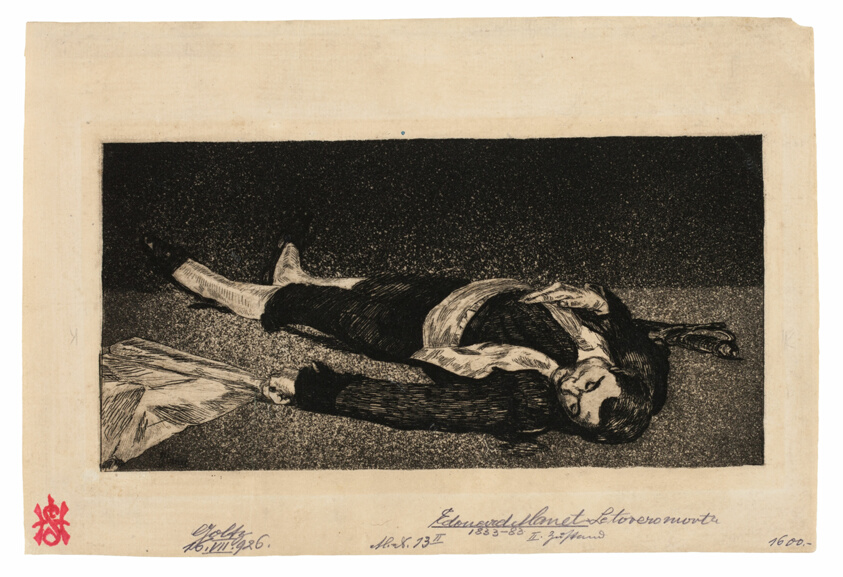
Dead Toreador
Édouard ManetLinkedCulture matchlcp-1088101e6ec3
- Date
- 1867–68
- Medium
- Etching, aquatint, and drypoint in black on buff laid paper
- Culture
- France
- Department
- Prints and Drawings
- Institution
- Art Institute of Chicago
- Object ID
- 69033
From the Art Institute of Chicago record
The Salon on 1864 included Manet's painting Episode from a Bullfight , which he later divided into two fragments, both reworked as single compositions. One of the fragments, the Dead Toreador (now in the National Gallery of Art, Washington, D.C.), was first exhibited in 1867, and the etching shown here dates from that time or shortly after. The etching itself was exhibited in the Salon of 1869 with Exotic Flower , which is stylistically similar and also of a Spanish theme.
The authoritative record is held by Art Institute of Chicago. LinkedCulture surfaces this object and its connections; it does not alter institutional metadata.
Get printable QR codesHide QR codes
Open QR codes for this object page and the museum record. They stay collapsed until needed.
Provenance & credit
As published by the source institution. Coverage varies — not every institution's open-data feed includes ownership history.
- Credit line
- Purchased with funds provided by Dr. Eugene A. Solow; William McCallin McKee Memorial and Joseph T. Ryerson endowments; Print and Drawing Club Fund
Linked open data
Authority identifiers that link this record into the wider web of cultural data — stable references you can follow to the source.
- Object type
- AAT300041273
Related across collections
Semantically similar works from Art Institute of Chicago and other institutions.