Art Institute of Chicago
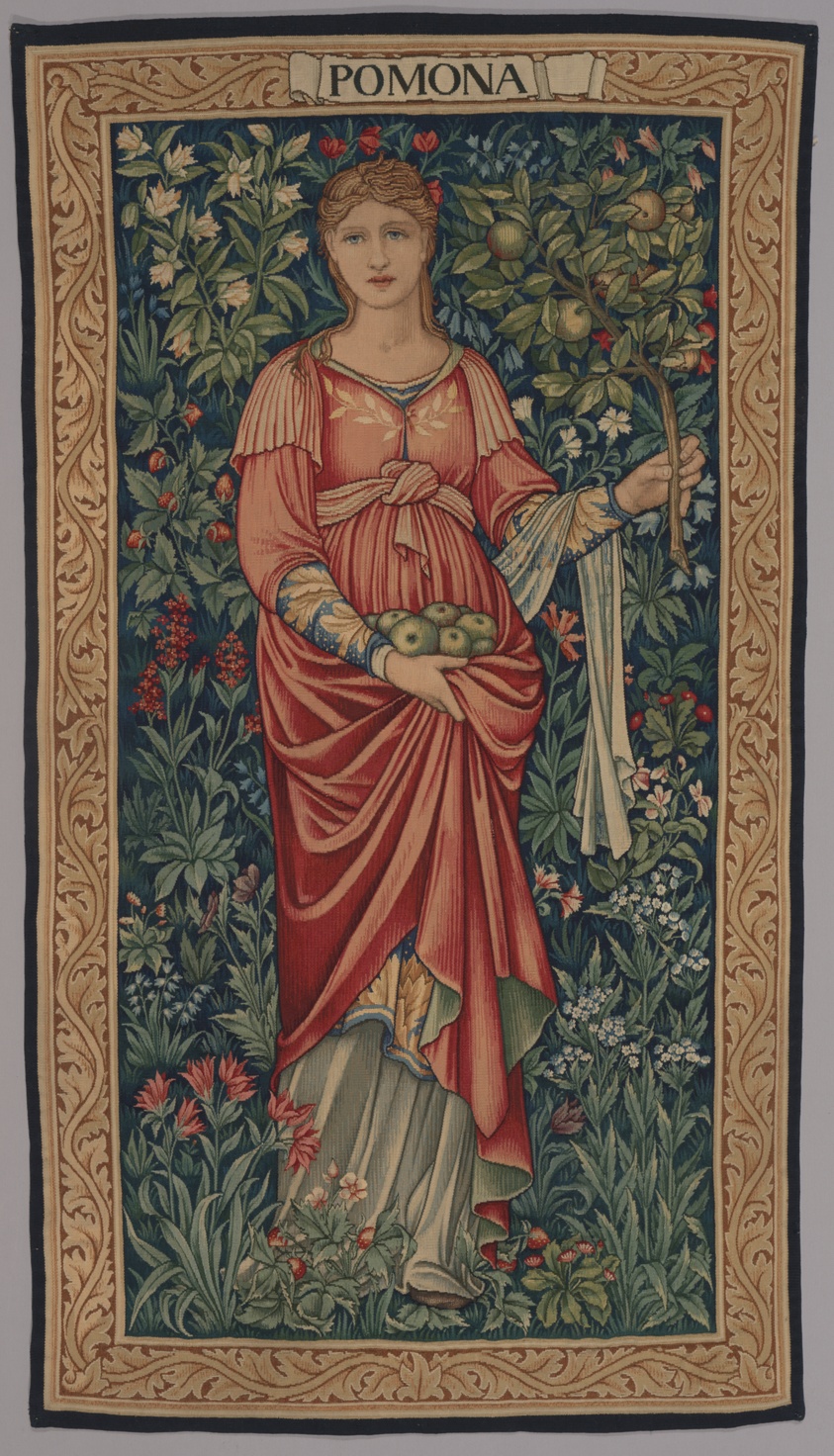
Pomona
After designs by Sir Edward Burne-Jones (English, 1833–1898) and John Henry Dearle (English, 1860–1932)LinkedCulture matchlcp-5e855523c73f
- Date
- Figure design 1882, background design 1898, made 1906
- Medium
- Cotton, wool, and silk, slit and double interlocking tapestry weave
- Culture
- England
- Department
- Textiles
- Institution
- Art Institute of Chicago
- Object ID
- 76634
From the Art Institute of Chicago record
William Morris called tapestry weaving “the noblest of the weaving arts . . .in which nothing is mechanical.” The weaver’s skill in interpreting a complex and often delicate design was essential to creating a successful work. Tapestry weaving is slow and therefore expensive, which made such textiles inaccessible to most consumers. The hanging of Pomona, the goddess of orchards and gardens, was paired with another tapestry depicting Flora, the goddess of flowering plants. The first version of this pair was woven in the mid-1880s with a bold background of large leaves designed by William Morris. Smaller versions were later produced with the millefleurs design in the background by John Henry Dearle. The floral background resulted in a more harmonious composition, as Dearle’s smaller flowers were better suited to the delicate rendering of the goddesses.
The authoritative record is held by Art Institute of Chicago. LinkedCulture surfaces this object and its connections; it does not alter institutional metadata.
Get printable QR codesHide QR codes
Open QR codes for this object page and the museum record. They stay collapsed until needed.
Provenance & credit
As published by the source institution. Coverage varies — not every institution's open-data feed includes ownership history.
- Credit line
- Ida E. S. Noyes Fund
- Provenance
- Ananda Kentish Coomaraswamy (1877–1947), London, from 1906 [purchased at Merton Abbey Tapestry Works, London, according to Thurman in Brosens, 2008, pp. 352-355; Day Book 9, p. 82 received at AIC on Dec. 12, 1917]; sold to the Art Institute of Chicago, 1919.
Linked open data
Authority identifiers that link this record into the wider web of cultural data — stable references you can follow to the source.
- Object type
- AAT300014063
Related across collections
Semantically similar works from Art Institute of Chicago and other institutions.