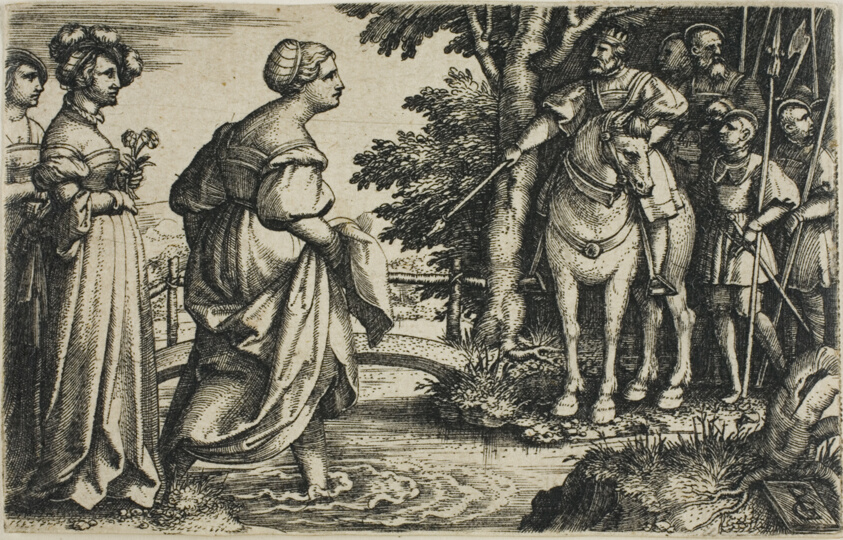
The Queen of Sheba Avoiding the Wooden Bridge

Art Institute of Chicago

The Queen of Sheba Avoiding the Wooden Bridge

Georg Pencz

Date
c. 1532
Medium
Engraving in black on ivory laid paper
Culture
Germany
Department
Prints and Drawings
Institution
Art Institute of Chicago

The authoritative record is held by Art Institute of Chicago. LinkedCulture surfaces this object and its connections; it does not alter institutional metadata.

Linked open data

Authority identifiers that link this record into the wider web of cultural data — stable references you can follow to the source.

Object type
AAT300041273

Related across collections

Semantically similar works from Art Institute of Chicago and other institutions.

The Suspension Bridge on the Border of Hida and Etchū Provinces

The Suspension Bridge on the Border of Hida and Etchū Provinces

Minneapolis Institute of Art

Ravana addresses Sita in the garden of Lanka, from Chapters 53 and 54 of the Aranya Kanda (Book of the Forest) of a Ramayana (Rama’s Journey)

Ravana addresses Sita in the garden of Lanka, from Chapters 53 and 54 of the Aranya Kanda (Book of the Forest) of a Ramayana (Rama’s Journey)

Cleveland Museum of Art

Royal women shooting from a pavilion

Royal women shooting from a pavilion

Cleveland Museum of Art

Khusrau, the King of Kings, pays homage to the pious daughter of Khassa, from a Tuti-nama (Tales of a Parrot): Fifty-first Night

Khusrau, the King of Kings, pays homage to the pious daughter of Khassa, from a Tuti-nama (Tales of a Parrot): Fifty-first Night

Cleveland Museum of Art

Akabane Bridge in Shiba (Shiba Akabanebashi no zu), from the series "Famous Places in the Eastern Capital (Toto meisho)"

Akabane Bridge in Shiba (Shiba Akabanebashi no zu), from the series "Famous Places in the Eastern Capital (Toto meisho)"

Art Institute of Chicago

The vagabond crosses a stream with the possessions of the daughter-in-law of the king of Banaras and absconds, from a Tuti-nama (Tales of a Parrot): Sixteenth Night

The vagabond crosses a stream with the possessions of the daughter-in-law of the king of Banaras and absconds, from a Tuti-nama (Tales of a Parrot): Sixteenth Night

Cleveland Museum of Art

King Bahram, who has married Khassa’s daughter, has her tied to a camel to be abandoned in the desert as a result of false accusations made by Khulasa, from a Tuti-nama (Tales of a Parrot): Fifty-first Night

King Bahram, who has married Khassa’s daughter, has her tied to a camel to be abandoned in the desert as a result of false accusations made by Khulasa, from a Tuti-nama (Tales of a Parrot): Fifty-first Night

Cleveland Museum of Art

Kanasugi Bridge at Shibaura

Kanasugi Bridge at Shibaura

Minneapolis Institute of Art

The queen of Rum watches the peahen prefer to burn rather than abandon her eggs while the peacock flees the nest, from a Tuti-nama (Tales of a Parrot): Thirty-ninth Night

The queen of Rum watches the peahen prefer to burn rather than abandon her eggs while the peacock flees the nest, from a Tuti-nama (Tales of a Parrot): Thirty-ninth Night

Cleveland Museum of Art

Habbaza’s sister, who is sent to console her, discovers the disguised Arab in her place, from a Tuti-nama (Tales of a Parrot): Twenty-fourth Night

Habbaza’s sister, who is sent to console her, discovers the disguised Arab in her place, from a Tuti-nama (Tales of a Parrot): Twenty-fourth Night

Cleveland Museum of Art

Mahrusa kills herself at the tomb of the king of Zabul, and her husband does likewise, from a Tuti-nama (Tales of a Parrot): Thirty-sixth Night

Mahrusa kills herself at the tomb of the king of Zabul, and her husband does likewise, from a Tuti-nama (Tales of a Parrot): Thirty-sixth Night

Cleveland Museum of Art

The disguised Arab, substituting for Habbaza, is whipped by her husband for refusing a bowl of milk, from a Tuti-nama (Tales of a Parrot): Twenty-fourth Night

The disguised Arab, substituting for Habbaza, is whipped by her husband for refusing a bowl of milk, from a Tuti-nama (Tales of a Parrot): Twenty-fourth Night

Cleveland Museum of Art