Art Institute of Chicago
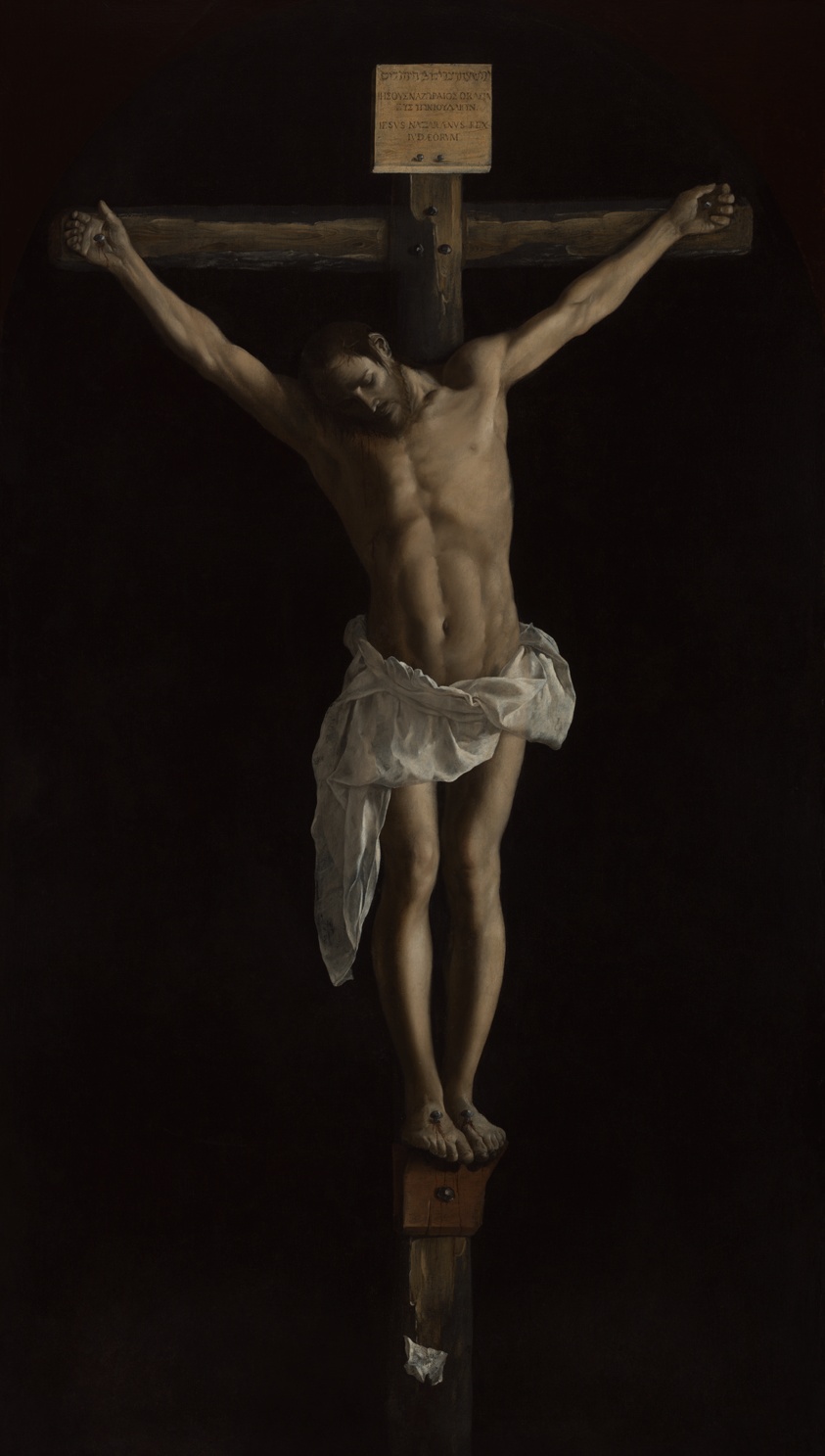
The Crucifixion
Francisco de Zurbarán (Spanish, 1598–1664)LinkedCulture matchlcp-e19a2d29125f
- Date
- 1627
- Medium
- Oil on canvas
- Culture
- Spain
- Department
- Painting and Sculpture of Europe
- Institution
- Art Institute of Chicago
- Object ID
- 80084
From the Art Institute of Chicago record
In 1626 the Dominican monastery of San Pablo el Real in Seville, Spain, commissioned the young Francisco de Zurbarán to execute a cycle of paintings including The Crucifixion . This work was installed in a dimly lit space in the monastery and was visible to visitors through a grill. Early commentators remarked on its powerful illusion of three-dimensionality, as though it was a sculpture rather than a painting. The dramatically illuminated figure of Christ, set against a dark, empty background, appears outside of time and place, both idealized in its quiet beauty and humanized by the individualized face and insistent realism.
The authoritative record is held by Art Institute of Chicago. LinkedCulture surfaces this object and its connections; it does not alter institutional metadata.
Get printable QR codesHide QR codes
Open QR codes for this object page and the museum record. They stay collapsed until needed.
Provenance & credit
As published by the source institution. Coverage varies — not every institution's open-data feed includes ownership history.
- Credit line
- Robert A. Waller Memorial Fund
- Provenance
- Painted for the sacristy of the Dominican monastery San Pablo el Real, Seville; placed on deposit at Palacio Real, Seville, on the order of Joseph Bonaparte, King of Spain, 1810 [see M. Gómez Imaz, 1917, p. 141, no. 224]; acquired by General Jean Toussaint Arrighi de Casanova, Duc de Padoue (died 1853) shortly thereafter [as recounted by his son to Father Stanislas Du Lac, S.J.; see letter from Father Du Lac to Father Paul Troussard dated 16 February 1901 and preserved at the Bibliothèque Sèvres, Paris, copy in file]; by descent to his son, Ernest Louis Hyacinthe Arrighi de Casanova, 2nd Duc de Padoue, given by him to Father Stanislas Du Lac S.J. (died 1909), rector of the Collège Saint Geneviève, Paris, 1876 [see letter cited above; Father Du Lac explained that he received the painting in thanks for his spiritual assistance to the duke's wife]; probably taken by Father Du Lac to St. Mary's College, Canterbury for the period between 1880 and 1890 and likely remained at Canterbury when St. Mary's College was replaced by a Jesuit school for novitiates; it was apparently moved from Canterbury to Laval along with the Jesuit novices' school in 1897 and was in Laval in 1901 [see letters from Jacqueline Diot and Father Du Lac in curatorial file]; transferred from Laval to the Jesuit seminary of Saint Louis at Jersey [see note with Du Lac letter]; transferred with the seminary to Chantilly in 1951 [see undated typewritten notes in curatorial file]. Dr. H. F. Fankhauser, Basel, 1952 [See Baticle in New York, 1988]; sold to the Art Institute, 1954.
Linked open data
Authority identifiers that link this record into the wider web of cultural data — stable references you can follow to the source.
- Object type
- AAT300033618
Related across collections
Semantically similar works from Art Institute of Chicago and other institutions.