Art Institute of Chicago
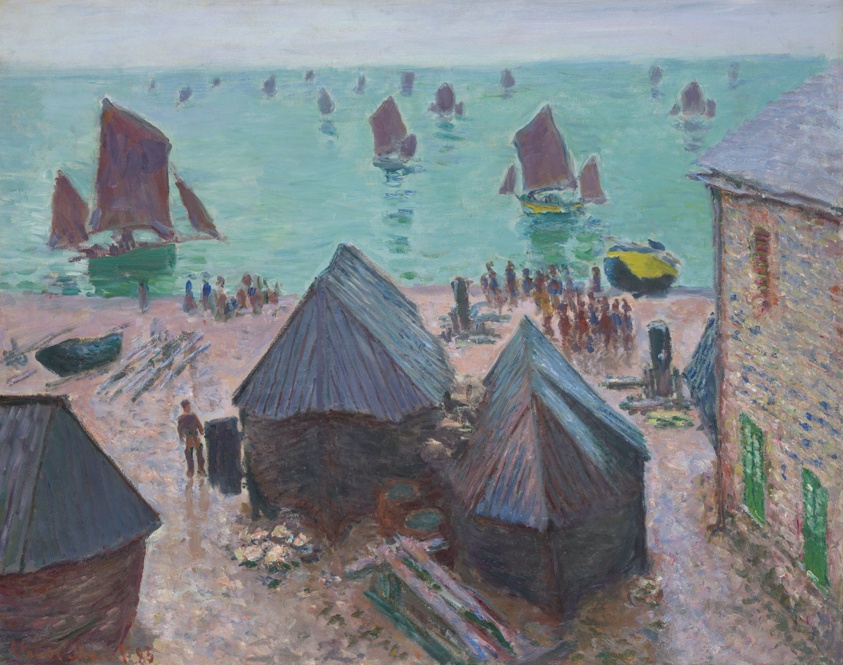
The Departure of the Boats, Étretat
Claude Monet (French, 1840–1926)LinkedCulture matchlcp-8e614afd9c71
- Date
- 1885
- Medium
- Oil on canvas
- Culture
- France
- Department
- Painting and Sculpture of Europe
- Institution
- Art Institute of Chicago
- Object ID
- 81540
Forced indoors by inclement fall weather, Claude Monet painted Boats on the Beach at Étretat and The Departure of the Boats, Étretat while looking out the window of his room at the Hôtel Blanquet. The two form a pair that share a palette, subject, and vantage point. In one of his daily letters to his companion and future wife, Alice Hoschedé, dated November 24, 1885, Monet described first Boats on the Beach and then Departure of the Boats : “In the afternoon, I worked in my room on my caloges [retired fishing boats covered with tarred planks and used for storage] in the rain, then I attempted to do, always through the window, a picture of the boats departing.” Monet centered each composition on the boats, combining pastel blues, pinks, purples, and greens to render wet surfaces. The brightly colored hulls of beached crafts lend relative scale to the structures in Boats on the Beach , and the groups of figures at the water’s edge, composed of quick, gestural strokes, register human activity in Departure of the Boats . Monet purposefully arrived well after tourist season, so it is unclear whether he observed the fashionably dressed women at left or rather inserted them as a foil to the local fishermen at right.
The authoritative record is held by Art Institute of Chicago. LinkedCulture surfaces this object and its connections; it does not alter institutional metadata.
Get printable QR codesHide QR codes
Open QR codes for this object page and the museum record. They stay collapsed until needed.
Provenance & credit
As published by the source institution. Coverage varies — not every institution's open-data feed includes ownership history.
- Credit line
- Potter Palmer Collection
- Provenance
- The artist (d. 1926); sold to Durand-Ruel, Paris, December 21, 1892, for 6,000 francs [this and the following per Durand-Ruel, Paris, stock book for 1891–1901 (no. 2548, as Caloges d’Etretat), as confirmed by Paul-Louis Durand-Ruel and Flavie Durand-Ruel, Durand-Ruel Archives, to the Art Institute of Chicago, Feb. 5, 2013, curatorial object file]; sold to Potter Palmer, Chicago, Dec. 21, 1892, for 6,000 francs; by descent to Bertha Honoré Palmer (wife of Potter Palmer), Chicago; on deposit from Bertha Honoré Palmer, Chicago, to Durand-Ruel, New York, Mar. 17, 1909–May 9, 1911 [per Durand-Ruel, New York, deposit book for 1894–1925 (no. 7535, as Caloges d’Etretat, 1885), as confirmed by Paul-Louis Durand-Ruel and Flavie Durand-Ruel, Durand-Ruel Archives, to the Art Institute of Chicago, Feb. 5, 2013, curatorial object file]; by descent to the Potter Family, Chicago; given to the Art Institute of Chicago, 1922.
Linked open data
Authority identifiers that link this record into the wider web of cultural data — stable references you can follow to the source.
- Object type
- AAT300033618
Related across collections
Semantically similar works from Art Institute of Chicago and other institutions.